20100627

AL Intercentury Luxura spotted in Chennai

As reported quite often in this blog and everywhere else, the Commercial Vehicle space in the Indian market has evolved in the past few years. The bus segment in particular was given a shot in the arm in the form of Volvos and it has not looked back ever since. The erstwhile coaches by Tata and Ashok Leyland suddenly felt that the death-knell for their monopoly has been rung and it’s time for them to roll up their sleeves. One of the many models that were conceived to compete with Volvo B7R was the Intercentury Luxura, the body of which was built by Irizar-TVS and the chassis provided by Ashok Leyland. Though the model was launched with much fanfare at the 2006 Auto Expo and was displayed at a couple of auto expos, it had never seen the light of the day completely, the recent economic recession notwithstanding. Though there were reports of trial versions being used by APSRTC and a few other private operators, except for one or two rare sightings, absolutely none of these buses were spotted elsewhere.

Thats why, when I saw this model a couple of days back, I decided it was time for me to take out my cam and laptop. There was this white colored Intercentury Luxura with no badging, logos or registration running in stop-start Chennai city traffic. From what I saw, the bus seems to have good presence on the road and it did manage to turn a few eyebrows. Although the quality of the body was top-notch, there were no ground breaking design elements on this bus. When seen next to a Volvo, the Intercentury Luxura will not get a second glance for sure. 

While the Intercentury Luxura originally launched in 2006 was front-engined, I guess this one had it's engine at the rear, thus crucially spilling out information that Ashok Leyland is going to make a comeback with this model. NVH levels inside are bound to be higher than the Volvos though external refinement was observed to be good. Even after so many unprecedented delays over the past half-decade, I still feel Ashok Leyland can make a good business deal out of this model if it launches and markets this aggressively, especially to State Transport Corporations. A couple of years down the line, time will run out for this model forever. Hope Ashok Leyland will not let this beautiful model die a slow death.

20100626

Maruti-Suzuki all set to continue it's Indian dominace

I read that this company came into existence with a group of people who had nothing but a “World Car Guide” in their hand. After some failed attempts with other manufacturers, Indian Government finally decided Suzuki as it’s JV partner in designing and developing a small car for India. Maruti Udyog Limited, was thus born and with that deal, Suzuki had struck gold, which it would realize almost two decades later. After almost 25 years of existence, nay “sheer dominance” of the Indian automotive market, Maruti (now Maruti-Suzuki) finds itself in an enviable position. It holds a vice-like grip of the Indian market and commands a 54% market share in the world’s second fastest growing auto industry. Whenever Hyundai and Tata try to gain market share by posting higher sales numbers, Maruti-Suzuki grows more than that and makes a mockery of the competition.
 
The model contributing to all this success in the recent years is the ever desirable Swift. During it’s launch, it came as a whiff of fresh air from a company which has hitherto made efficient and practical but dull and tinny cars. This was the first ever model launched by Maruti simultaneously with it’s international debut. And the public reaction and response was there for Maruti and it’s competitors to see. Now, imagine this. A car, after almost 5 years of it’s launch, still commands a 2 month waiting list in the market. A car, along with its sedan version Swift Dzire, is the largest selling model in the Indian market. A car, which at the end of it’s life cycle and when about to be replaced, still looks so fresh and appealing. The Swift is all the above and more for Maruti-Suzuki.
 
And that’s why, when Suzuki unveiled the images of the all-new next generation Swift in the web, it has caught the attention and frenzy of the people. If there was one car model which had a huge success story written on it even before it’s launch, or heck, even before any news about it from the manufacturer itself, it should undoubtedly be this. The new Swift, in all probability should see the light of the day by next year and I am sure it’s going to rewrite the sales book records. And not wanting to spoil an already great design, Suzuki has played safe by making this new Swift an evolution of the existing model. While doing so, Suzuki has also addressed the only grouse that most of the existing Swift owners had - less passenger space in the rear. The new Swift has grown up in size and it looks the part too. Having said that, I think, if the rear styling of the present Swift was acceptable, the rear of the new model looks quite ugly to many, going by the response in automotive forums across the world. Nevertheless, it’s a great new car that’s going to come at a great price.

With the impending launch of the Kizashi, Suzuki’s sporty executive sedan, the sun is shining brighter than ever for Maruti-Suzuki. And that’s when all the manufacturers are making a bee-line to grab a foothold in this market.

20100508

Comparo #1: Tata Marcopolo vs AL Viking

Automobiles are a constantly evolving species. In no other species of machines are the technological advancements so constantly viewed by the public as in case of automobiles. India is no exception in the above statement and though it took a little while to catch up with the rest of the world, the Indian passenger car industry is now up there, offering the best money and technology can offer. While this has been the case of cars, the case of Commercial Vehicles in India has nothing to write home about. It has simply not kept pace with the international standards in this very price-sensitive market, more so in this segment. Volvo changed it all in the Public Transport segment making people realize the advancements and creature comforts that the modern day buses have in other countries. Since then, the buses in our country have been trying hard to match the standards set by Volvo and in the process, the entire industry has seen a remarkable turnaround. Even the Government run public transport organizations are not left alone in this business with the fear of being smoked by the private competitors.

Thanks to all these, the buses in Indian cities, especially metros now present a much better picture and not the same old sad story as, say a decade back. The fleet is being regularly revamped, new buses are being introduced in much higher frequencies, they are no longer being confined to only metros and big cities and above all, a healthy competition is brewing up between the largest local manufacturers, Tata and Ashok Leyland. Both the manufacturers are going all out in modernizing their existing models and platforms and hurrying up new launches like never before. In addition to that, both are making inroads into what has been traditionally the other manufacturer's stronghold. The increasing number of Ashok Leylands in Delhi and the ever-multiplying number of Marcopolos criss-crossing Chennai bear testimony to that. While every new launch in passenger cars or bikes catch the attention of the general public, especially today's young brigade, they tend to turn a blind eye when it comes to public transport buses, the latest misses being the Viking series and the Maropolo series from Ashok Leyland and Tata respectively. Being the ever-enthusiastic auto-freak that I am, these new buses never missed my eyes or my lenses.

Exterior Design:
The Tata Marcopolo is built in a spanking new facility in Karnataka while the Viking series has been built by many coach builders like Prakash, Veera, Irizar-TVS and the like with Ashok Leyland providing them the bare chassis and the design factors. Seeing them on atleast a couple of dozens of instances everyday, Tata Marcopolo stands out with the most modern design of the two. When viewed head-on, the Viking tends to pose some threat to the Marcopolo with it's modern multifocal headlamps lending a touch of class and modernness to an otherwise traditional design. The Marcopolo is also quite a looker with it's Volvo-inspired headlamp design. Where the Tata trounces the Viking is in the safety aspect with it's two huge wiper blades covering the entire windshield compared to the paltry single blade in the Viking, hardly enough to cover the driver's side of the huge windshield. The story from the rear is a sloppy one-sided affair with the Viking coming with a decade-old but trustworthy design. The Marcopolo exudes a level of modernness and follows the same design theme like the front with circular-themed tailights, plastic shrouds for the lights and body-colored plastic bumpers.

Interiors:
The Marcopolo scores in the interior design department as well with well-appointed, spacious seats and good level of standard features, the most notable among them being the "Emergency Stop" button in each of the vertical rods that supports standing passengers. The ergonomics around the driver's seat is also impeccable with everything falling nicely to hand and easy to operate. The only noticeable grudge is the lever for holding the windows open, which is very old-school and could have been easily replaced with something much better. The Viking though comes in a tried and tested, less-modern, interior design that does not disappoint both the drivers and the common public. The only grouse is the uneven height of the seats directly above the rear wheels thus reducing the space available for the passengers in the next seats. There is a lost of weight reduction in the Marcopolo with Tata preferring plastic over sheet-metal in many places. Though it serves as a great advantage in the mileage aspect, the long-term reliability of those parts are still unknown.

The Ride:
From what I experienced, the Viking seems to have a better pick-up both when starting from a standstill and while climbing inclines, though this may also be completely because of the driving skills of the respective drivers involved. But, I have noticed it on more than a couple of occasions. Also, the Viking's engine  seems to burn fuel and combust more efficiently than the Marcopolo as it does not spew smoke out of it's exhausts like Marcopolos do. I have seen old Marcopolos emitting a plume of black smoke in Delhi and Bangalore but I was shocked to see barely weeks-old new Marcopolos doing the same in Chennai. It definitely needs to be given a thought by Tata. The Viking also seems to have better riding comfort as it sails over road undulations with minimum fuss unlike the Marcopolo which strains itself in situations like this, with it's modern frame and construction designed for truly modern roads. The Marcopolo, though is extremely refined and vibration-free unlike the Viking. Particularly impressive was it's refinement at idle, to such an extent that it was difficult for passengers at the rear to make out whether the engine was switched on or not.

Verdict:
As such, the Tata Marcopolo seems to have just edged out the Viking in the initial race going by the feedback of the general public, but only time will tell whether the new Tata will hold it's own against the rock-solid reliability that has endeared the Ashok Leyland Vikings to the traveling public. On a last note, the drivers I spoke to seem to prefer the older and traditional Vikings to the Marcopolos. As they say, it takes time to change perceptions.

20100501

Hyundai premieres next-gen Avante/ Elantra in Korea

If you had been following my posts regularly, it would have struck you by now that this is the third consecutive post about the Korean juggernaut Hyundai. And before accusing me of giving undue advantage to this particular manufacturer, tell me one automaker who has had Global Premieres of two of it's bread and butter models in less than a week. Yes, merely days after global unveiling of the next-gen Verna/Accent in China, here comes Hyundai with the global premiere of it's next-gen Avante/Elantra at the Busan Motor Show in Korea. It's as if Hyundai has answered to my question in the previous post.
 
The current Elantra and it's predecessors achieved global sales successes and raked in the money and volumes for Hyundai but none of them can even be remotely called good-lookers. But I am sure, this new model will shatter that perception to pieces once launched in the market. I would even go far ahead and tell that this new Elantra is the best looking car in it's segment and by far the best looking Hyundai to date. None of the company's models in the past 43 years of it's existence can even come close to this beauty, except maybe the Genesis Coupe. This Elantra takes the company's now-famous Fluidic Sculpture design theme and comes out as the best of the lot wearing it.

The flowing headlamps and taillamps, the hexagonal grille, the character lines in the sides, the bulging wheel arches, the way in which the V-shaped creases in the bonnet merges with the top of the grille, the strong-yet-subtle touches of chrome in the split grille, the coupe-like roofline, the slingshot mirrors with integrated repeaters, all gel so wonderfully together to make this one stunning looking car. I would say that this is the only car which can hold it's own design-wise to the superb Honda Civic which still looks fresh and great, years after it's launch. The one aspect of the new Elantra which seems to be inspired is the way in which the A-Pillar merges with the bonnet - a straight lift from the Civic. Not a bad thing at all.

The interior shots and the engine and transmission specifications are not yet released, but it's expected to come with Hyundai's latest Gasoline Direct Injection (GDI) engines and if Hyundai permits, the Turbo too. But do you  really care? I won't, if I were in the market for this type of car. These looks are enough to entice me into buying this one. Already waiting for the next launch from you, Hyundai. Hope, you are listening!

20100424

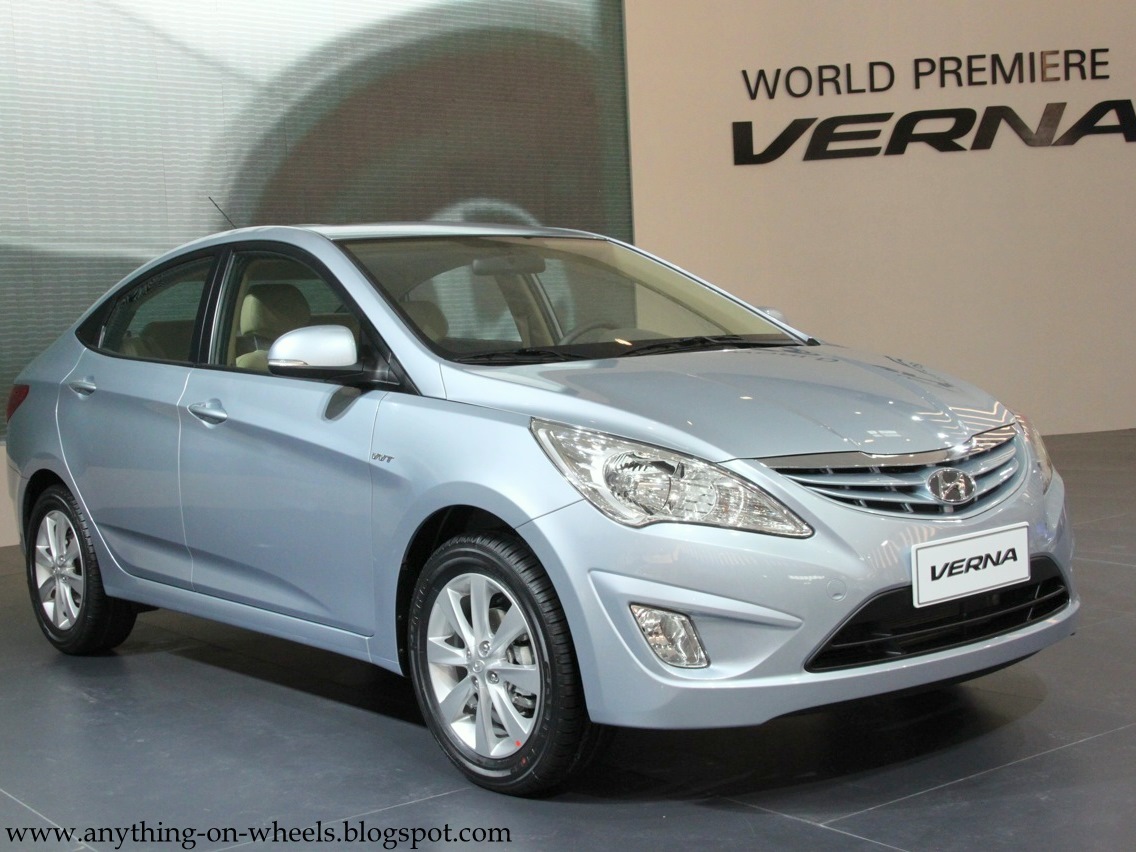
Hyundai premieres next-gen Accent/Verna in China

It's a known fact now that Hyundai is on a roll, of late. Most of the hype surrounding this Korean brand, in recent times, is due to a term called "Fluidic Sculpture." Hitherto known for dishing out bland and unimaginative designs inspired by other brands, Hyundai took a U-turn on it's design philosophy by incorporating the Fluidic Sculpture design elements in it's models. We saw how it has been put into good effect in the recently launched Sonata and Tucson  models. And the car-buying public seem to love it too, with both the above models becoming instant hits and raking in unprecedented volumes for Hyundai.  Now the same concept has been watered down into Hyundai's sub-compact Accent model.

With the recent global premiere of the next generation Accent (Verna in most parts of Asia) in China, Hyundai has made it official that it's models are going to have a family look incorporated into them. Up front, the new Accent has two creases in the bonnet which makes it's way through to end at the bottom of the grille. The grille itself carries a slightly squished look corresponding to the  creases in the bonnet. Huge, swept-back headlights dominate the front end and the mirrors now have turn signals in them. The profile is dominated by the strong character line that starts from the front fender and ends just above the taillights. The wedge in the bonnet that starts from the headlights and merges into the side doors is sure to be noticed. All these are design elements found in the Sonata sedan too and it surely lends an upmarket look to the Accent. In short, it looks like a mini Sonata with all the striking design elements slightly toned down to suit the tastes of this segment.

One look at the interiors will prove that there is a sea change in the interior design department too. While the current model's interiors is as unimaginative as it's exterior design, the new model has a much nicer look to it's interiors. The steering wheel seems to have been lifted straight from the i20 hatch and the center console, with it's combination of colors and contours, looks quite good. Personally, I like the satin silver and black finish of the center console and Hyundai will be hoping that the interiors are well-received by the public too (though not to the extent of the exterior design). The new model is expected to be powered by Hyundai's Gamma 1.4 and 1.6 gasoline engines and also, the much-loved in India and eagerly awaited Common Rail diesel engine. Though the exact specifications of the engines are still not clear, we Indians know how the CRDi mills of Hyundai are and this will be no exception. When Hyundai finally launches this model in India sometime next year, it will have it's task cut out, competing with models such as Honda City, Toyota Etios, VW Vento (Polo sedan), Fiat Linea and the Indigo Manza.

Now that the Sonata and Accent are out, will Hyundai take the wraps off the next-gen Elantra soon?