20190207

Driven - 2019 Hyundai Santro

Variant Driven: Sportz Auto


'Santro' is a name that needs no introduction in India. With 1.32 million out of the total 1.86 million units made finding customers across the country, this was the car that established Hyundai as a popular mainstream car-maker here. So, when Hyundai decided to bring the car back after a four year absence, you know the stakes are high. Does the new Santro meet the expectations? Will it satisfy the thousands of loyal owners waiting to upgrade to a newer and better model? Can it do what the Eon couldn't and take the fight to Maruti-Suzuki? In short, can the new Santro do what it's predecessor did all over again? 

We found out by spending a better part of the day on the top-end automatic variant.   

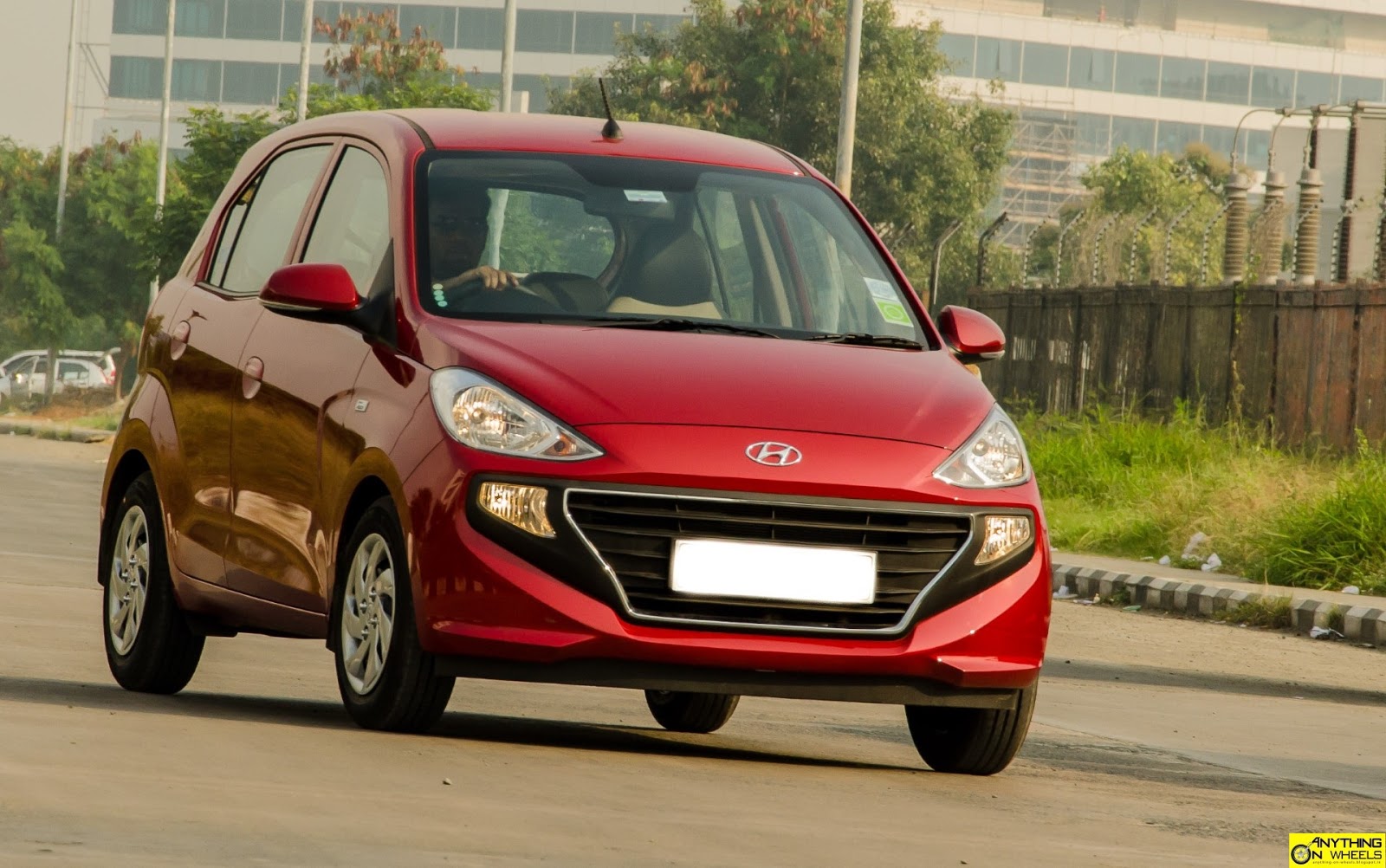
The Santro is still a quirky-looking car

The original Santro was actually derived from a car the South Koreans know as the Atos. Feedback from customer clinics in India where the car was showcased was apparently so bad Hyundai decided to give the car a nip and tuck along with a new name. Despite getting rid of the van-like rear end, the made-for-India Santro still wasn't a looker. It's bug-eyed headlights, toothy grille, tall-boy proportions and odd-ball derriere made it one quirky little car. 

The all-new Santro continues the tradition and is a fresh and modern take on the quirkiness it's predecessor made popular. 


Up front, high-set wraparound headlights that aren't disimilar to the old i10 give the new Santro a familiar look. A w-i-d-e grille - one that runs the full width of the car - is located right below and makes the car look broader than it actually is. Fog lamps and the registration plate are housed within the confines of the grille. Walk over to the sides and a pair of boomerang-shaped creases scream for attention. In what's a classic case of function being prioritized over form, the window line drops mid-way to make the interiors feel airy and less claustrophobic. Those who prefer clean profiles are likely to be put off with this busy design. At the rear, a pair of small trapezoidal taillights sit on either side of a sculpted hatch. The bumper gets a wide black insert that successfully breaks the monotony and adds a bit of flair.


Clearly, this is a love-it or hate-it design. While the design grew on me by the time I returned the car to it's owner, our photographer felt Hyundai could've done better. After all, the Grand i10 and i20 that share showroom space with the Santro look far more stylish and modern.

Interiors are a treat for the price

When you buy a Hyundai car, you sort of expect quality interiors with fit and finish that rival cars a segment or two higher. With the new Santro, the Korean car-maker has managed to deliver that, yet again. In fact, quality levels in the cabin are so impressive that the Celerio we used as a support car for the shoot felt downright cheap next to the Hyundai. Yes, there's cost cutting and we're getting to that a little later but whatever is in there is nicely put-together and likely to withstand abuse.


The moment you step in, you're bound to be impressed by the well-designed and neatly laid-out dashboard. Hyundai's designers seem to have taken inspiration from a host of places (and cars, obviously) to design this cabin. The two propeller-shaped air-conditioner vents are straight out of an A-Class while the brushed metal inserts on the steering wheel and around the gear lever and the central vents are painted 'Rose Gold' to rival the latest smartphones out there in the market. All the controls fall nicely on hand with the only major ergonomic flaw being the centrally-positioned power window switches. Be it the control stalks, the buttons on the steering wheel, the rotary knobs on the center console or even the re-circulation slider - every one of them is of decent quality and doesn't feel cheap. As always, Hyundai has raised the bar in this segment.


Thanks to the 'Tall Boy' design, the interiors are spacious and practical - two virtues that made the old Santro a smash hit in India. The front seats are soft and supportive and it's quite easy to get to a comfortable position. On the other hand, fixed steering wheel seriously limits the flexibility for the driver. The rear bench is easy to step in and out of and - by virtue of being wider than many of it's rivals - can accommodate three decently-sized adults easily. The seat isn't placed low like some other small cars, so there is decent under-thigh support too. While the floor is almost flat, the first-in-segment rear air-conditioner vents does intrude into the leg space of the fifth passenger. What spoils the show though are the absence of adjustable head restraints. Boot space is decent enough and should have no problems gobbling up a family's average weekend luggage.  

Instrument Cluster: 


As the saying goes, little things here and there make a big difference overall. Santro's instrument cluster fits that statement to the tee. It's a simple unit, yes, but it looks cool and, dare we say, racy. Two overlapping semicircles house a speedometer and a tachometer with an MID screen to the right displaying vital statistics. The irregular outline adds to the visual flair while classy white-on-black fonts are just perfect in terms of visibility.

Read-outs include two trip meters, instantaneous fuel efficiency, average fuel efficiency, distance to empty, engine run time and average speed. 

Infotainment System:


The Sportz and Asta trim levels get a 7.0-inch touchscreen infotainment system with four speakers as standard. Equipped with all sorts of connectivity options like BlueTooth, USB and Aux and capable of supporting Android Auto, Apple CarPlay and Mirror Link, this modern entertainment system is all that you'll ever need. Moreover, the system is intuitive, the display quality is good and there is no lag to the touch.

Apart from the usual entertainment and telephonic options, the touchscreen also serves as a display for the rear parking camera (exclusive to the Asta variant) and lets users customize a host of in-car settings too. While the audio quality is definitely superior to what's being offered by most of the Santro's rivals, we have a feeling the Harman-developed system in the Tiago sounds better. Whether we accept it or not, it's a fact that touchscreens are a source of distraction whilst driving. That's where Hyundai's thoughtful approach of providing physical knobs and buttons for frequently-used functions needs appreciation.    

It's built to a cost.. and that's evident

After all, the Santro is an entry-level hatchback that competes in a highly-competitive and cost-conscious segment where a few thousands make a big difference and affect purchasing decisions. Hyundai had to keep costs in check to have a stab at success in this highly-competitive segment. But, have they gone a bit too far in doing that?

When was the last time you saw a new car sporting outdated flap-type door handles? The Santro, unfortunately, has them. Except Asta, none of the variants get a rear defogger, washer or wiper. Alloy wheels have been given a miss, even on the Asta.


The spree continues inside too. The Santro doesn't get adjustable head restraints; they're not on the front seats and they're not on the rear. That's hard to digest, given it's predecessor had them way back in 1998. That apart, the power window switches placed on the floor console between the front seats, the absence of chrome 'H' logo on the steering wheel, the wheel itself that's not adjustable for reach or rake and the awful slider button for turning the re-circulation mode on indicates the bean counters have had the upper hand. 

Yes, the overall design and ambience of the cabin does make up a bit but that can only take you so far!

The Santro is 'Made in India, for India'

The Santro - or the Atos that it's based on - isn't a globall successful model for Hyundai. With three-fourths of it's sales coming from India alone, it isn't surprising the new Santro was conceived and developed keeping Indian buyer's tastes and preferences in mind. 


For instance, the habit of placing a devotional idol on the dashboard is quite prevalent in India. Hyundai has given a nice and flat dedicated spot for that. Sounds silly, you think? You're wrong, we know of someone who is struggling to find a spot for an idol in his new Innova Crysta's sloping dashboard. The center console, Hyundai claims, is designed to look like an elephant's trunk. Look at it again and you'll realize the resemblance. The first-in-segment rear air-conditioner vents are another example. In a hot and humid country like ours, that makes a huge difference. 


As weird as it looks from outside, that downward kink in the window line helps massively when you're seated in the rear seat. The additional quantity of light that it lets in, together with the beige-and-black seats, makes the interiors feel more airy and spacious than it actually is. 

An automatic or full safety? Choose one... 


Hyundai's strange strategy of not pairing it's top-end variants with auto transmissions continue with the new Santro. Despite being the top-end automatic variant, our car didn't have an airbag for the front passenger. Only the Asta variant - which doesn't come with an AMT - gets it. None of the other variants, be it manual or automatic, gets one. At a time when there is increased awareness on safety, this is a glaring miss. With Maruti-Suzuki moving the game ahead and Tata piling on the pressure, we expect some feature corrections - and possibly a price correction too - for the Santro very soon.​

You get 4 in a segment full of 3s

​In a segment brimming with cars that fell victim to the 3-cylinder madness​, Hyundai did a 'whiff-of-fresh-air’ moment when it brought in an additional cylinder under the hood of the Santro. What should have been a huge competitive advantage was cut short by Maruti-Suzuki when it launched the all-new Wagon-R last month with both 3- and 4-cylinder engine options. That was out of the blue and Hyundai, we think, wouldn't have expected that. 


​Coming back to the Santro, powering this little hatch is a 1.1-liter 4-cylinder engine from Hyundai's 'Epsilon' series. If that sounds familiar, that's because the same engine powered the old Santro as well as the i10. With a cast-iron cylinder block that has 3-valves per cylinder, this is an old-school motor - albeit with the addition of variable valve timing for improved power and fuel efficiency. Delivering 68 horsepower at 4,500 rpm and 99 Nm of torque at 5,500 rpm, the Santro settles well in the middle of the pack when it comes to power and torque figures.


Turn the key on and the benefits of an additional cylinder is immediately felt. Santro’s refinement at idle as well as in motion is impressive. Get going and the car responds with a gradual build-up of pace. Within the confines of the city, this little Hyundai will have no problems in keeping up with traffic. Those who have driven the old Santro would know that car was the king of the urban jungle, thanks to it's superb low-end torque and peppy nature. The new Santro, sadly, isn't the same. The low-end response is just adequate but the car redeems itself by coming to life once the needle crosses 2,000 rpm. An impressive mid-range and linear power delivery makes the Santro enjoyable within the confines of the city. And while doing so, the fuel efficiency is pretty good too. If you're an i10 automatic owner, you will be genuinely surprised by how efficient this wannabe automatic Hyundai is!


Give it the beans out on a highway and the motor comes short. This isn't an engine that likes revving closer to the red line. It sounds strained and it doesn't reward you for all that noise it generates. 

Yippee, finally there is an AMT that isn't jerky!


As mentioned before, the car we drove was paired to an Automated Manual Transmission that Hyundai calls 'Smart Auto'. And smart it is, given this unit has none of the jerky nature that AMTs in general and the ones from Maruti-Suzuki and Tata in particular are known for. No, this isn't as smooth as a conventional automatic gearbox or a Continuously Variable Transmission (CVT). But, for what is Hyundai's first-ever AMT and that too an in-house developed unit, this is quite a triumph. You do feel the shifts in lower gears and things get progressively smoother as you hit higher gears. With the upshifts happening early, it's clear Hyundai has tuned the unit for better fuel efficiency. But you can bypass that by pressing the throttle pedal hard. The car holds its gear until you hit 6,000 rpm before going up a ratio. 


For those looking for some action to their left hand, there is a manual mode as well. Slot the stick in 'D' and move it right to engage. Push the stick up to upshift and pull it down to come down a gear ratio. It's definitely more engaging to drive this way but then it beats the purpose of buying a car equipped with an AMT. Overall, for those looking for a stress-free and jerk-free drive in urban confines, we would recommend the Santro Smart Auto without hesitation. 

Ride and handling are par for the course


Despite being a strong package, old Santro's 'Achilles Heel' was it's bumpy low-speed ride quality. We are glad to tell you Hyundai has rectified that in the new Santro. With a McPherson strut up front and a coupled torsion beam setup at the rear, the suspension hardware is standard fare. Thanks to comfort-oriented tuning, the ride quality is absorbent and bumps and potholes are taken care of well at slow and medium speeds. At high speeds, you do feel the road irregularities more. Thankfully, the improvement in ride doesn't come at the expense of handling. The new Santro handles much better than it's predecessor too. Body roll is well controlled despite the car's height and it doesn't scare you during sudden lane changes. But then, let's not forget this isn't a point-and-shoot kind of enthusiast's car.


Specifications at a glance


Dimensions

> Length x Width x Height – 3,610 x 1,645 x 1,560 mm
> Wheelbase – 2,400 mm
> Ground Clearance – 165 mm
> Fuel Tank Capacity – 35 l


Powertrain

> Configuration – I4
> Displacement – 1,086 cc
> Max. Power – 68 BHP @ 5,500 RPM
> Max. Torque – 99 Nm @ 4,500 RPM
> Transmission – Smart Auto AMT
> Fuel Efficiency – 20.3 km/l


Other Hardware

> Front Suspension – McPherson Strut
> Rear Suspension – Coupled Torsion Beam Axle
> Front Brake – Disc
> Rear Brake – Drum
> Tyre Size – 165/70 R14


To sum up


After having spent the better part of a day with the car, it's hard not to be impressed with the new Santro. Here is an entry-level hatch that doesn't feel cheap. Hyundai's little car not only gets us a tight build, high-quality interiors and a slew of segment-first features but also an extremely-refined engine paired to a smooth AMT (if we can call one that!). Sure, there are some glaring misses like the absence of a passenger airbag across the range and the quirky styling but this is one car you can't go wrong with. 

Problem is, Maruti-Suzuki sensed it before any of us could and the new Wagon-R is their answer. The Santro will have it's task cut out against it's arch-rival!


Text & Editing: Aravind Ramesh
Photography: Bharath Rengaraj

20190124

All-new Maruti-Suzuki WagonR launched

Merely months after Hyundai launched the new Santro in a bid to gain supremacy in the entry-level hatchback segment, Maruti-Suzuki has hit back by launching the third-generation WagonR in India. Consistently a best-seller, WagonR has been a huge success story for Maruti-Suzuki with a loyal fan following. The launch of this new model - priced between INR 4.19 Lakhs and 5.69 Lakhs - is a move by the leader to not let Hyundai invade it's turf.


WagonR has never been a style statement on wheels. It was - and still is - boxy with a design that gives precedence to function over form. The new model is no different. The squar-ish headlights that WagonR has always been synonymous with are retained, albeit stretched at the edges and swept back on to the sides. A new grille with a chrome insert in the middle and an updated bumper housing a large air dam and trapezoidal fog lamp pods complete the changes in the fascia. In profile, the ‘tall boy’ look and proportions are left intact. To add drama, a floating roof effect has been brought in the C-pillars and the character lines along the doors and wheel arches are more pronounced. At the rear, the WagonR now gets vertical taillights that extend till the roof.

Interiors have gone through a thorough update as well with a bright dual-tone dashboard replacing the dull grey interiors of the outgoing model. A 7.0-inch touchscreen infotainment system with Smartphone connectivity, Android Auto and Apple CarPlay takes prime place in the center console with manual air-conditioning controls placed beneath it. A 3-spoke multi-functional steering wheel and a digital tachometer greet the driver while the bigger cabin would help keep the occupants happy by offering more space and practicality.


Standard features on the new WagonR include driver airbag, Anti-lock Braking System with Electronic Brake-force Distribution, rear parking sensors, central locking and front power windows. The top-end variant, apart from the touchscreen infotainment system mentioned above, gets additional goodies like a passenger airbag, steering-mounted voice control, electrically-retractable rear view mirrors, rear wiper, washer and defogger and a storage tray under the co-driver's seat. It's sad Maruti-Suzuki isn't forcing Hyundai to follow suit by offering passenger airbags as standard in the WagonR. Thankfully, it's atleast an optional feature on all variants.


The biggest surprise element in the new WagonR rests under the hood. While the 3-cylinder K10B engine has been carried over from the outgoing model, Maruti-Suzuki has pulled off a master stroke by adding the more powerful K12M 4-cylinder engine to the WagonR lineup. While the former delivers 67 horsepower and 90 Nm of torque, the latter delivers 82 horsepower and 113 Nm of torque. Both the engines come with the option of a 5-speed manual or an automated manual transmission (AGS). Suspension duties are handled by MacPherson struts with coil springs at the front and torsion beam at the rear.

Bookings for the new WagonR opened just a week back and Maruti-Suzuki claimed over 12,000 bookings at the launch event. Clearly, India's largest car-maker has another blockbuster in the making.

Tata launches the much-awaited Harrier in India

Tata Motors finally launched its much-awaited Harrier in India yesterday. This brings to an end an extended period of pre-launch build-up during which pretty much everything about the Harrier except the pricing and some specifications were known. That closing piece of the puzzle is out now.


Tata’s newest challenger is available in four variants. While the base XE trim level is priced at INR 12.69 Lakhs, the flagship XZ retails at INR 16.25 Lakhs. Sandwiched by them are the XM and XT variants, priced at INR 13.75 and 14.95 Lakhs respectively. All prices are ex-showroom Mumbai. That’s smart pricing by Tata, undercutting main rivals like the Jeep Compass and the Mahindra XUV500. At these prices, the Harrier is perfectly poised to pull in customers from segments above and below.

Featuring Tata’s Impact 2.0 design philosophy, the Harrier sports contemporary styling that’s in line with the global design trends. And by that, we refer to the split light clusters up front where LED Daytime Running Lights take up the spots erstwhile occupied by the headlights. The latter are placed below on a separate pod that also houses the fog lamps. The grille that merges with the DRLs is shaped to look like the ‘Humanity Line’ that’s seen on all recent Tata models. The silhouette has classic SUV cues with flared wheel arches and plastic cladding that runs the length of the car. The floating roof with chrome inserts and the thin wraparound taillights connected by a piano black insert give the Harrier a chic look from the rear. 


The interiors mark yet another step forward for Tata Motors. Harrier’s cabin is minimalistic, classy and, if initial impressions are anything to go by, appears nicely put-together too. The Signature Oak Brown interior colour scheme that’s shown in the picture together with the Oakwood finish applied on the dashboard look rich and inviting. Other attractions inside include a 8.8-inch ‘Floating Island’ on the center console that houses the infotainment system as well as a host of other controls, a part-digital instrument cluster, JBL-tuned sound system with nine speakers and an aero-throttle style parking brake. 

While most of the aforementioned goodies are exclusive to the XZ variant, standard kit across the line-up include power steering, central locking, power windows, dual front airbags, Anti-lock Braking System with Electronic Brake-force Distribution, tilt and telescopic-adjustable steering wheel, projector headlamps, rear parking sensors and perimeter alarm system.


If that’s bare-bones for you, Harrier XZ with exclusive features like Xenon HID Projector headlamps, front fog lamps with cornering function, premium Benecke-Kaliko Oak Brown perforated leather upholstery, outside mirrors with logo projection, Terrain Response Modes (Normal, Rough and Wet), six airbags, Electronic Stability Program, Hill Hold Control, Hill Descent Control, Roll Over Mitigation, Corner Stability Control and Electronic Traction Control is the one you should be looking at.

Harrier is built on Tata’s new Omega Architecture, a modular platform derived from Land Rover’s legendary D8 architecture. That’s the platform that underpins the Land Rover Discovery Sport. Expect the chassis to be robust and abuse-friendly, traits that Land Rovers are known and appreciated for worldwide. 


Currently, the Harrier is available with a sole diesel engine under the hood. This 2.0-liter, 4-cylinder diesel mill is named ‘Kryotec’ and derived from FCA’s MultiJet 2.0 that also powers the Jeep Compass. In the Harrier though, it is detuned to deliver 138 horsepower and 350 NM of torque, significantly less than the Jeep. Paired with this is a 6-speed manual transmission driving the front wheels. Neither All Wheel Drive nor an automatic transmission is on offer. With premium car customers and urban population preferring automatics these days, not having one in the lineup is a glaring miss. Worry not though, an automatic option is headed our way later this year, we hear.

With bold styling, plush interiors, potent engine and proven mechanicals, the Tata Harrier was already a tempting package. Spot-on pricing makes it just irresistible. Let’s wait and watch what this turns out to be for Tata Motors.

20190118

Toyota launches the all-new Camry Hybrid in India

India's first automotive launch of 2019 happened today with Toyota bringing in the new Camry Hybrid to our shores today. Currently in its eighth generation, Camry is offered here in a sole Hybrid variant and priced at an introductory pan-India ex-showroom price of ₹36.95 Lakhs. Incredibly for a Toyota, that's cheaper than the outgoing Camry!


Based on the Toyota New Global Architecture (TNGA) that also underpins the expensive Lexus ES 300h, the Camry ditches the staid styling elements it's been known for and adopts the brand's latest design language. The fascia has been given an aggressive treatment that's dominated by a V-shaped grille and a huge trapezoidal air dam that almost occupies the whole bumper. The car features sharp LED projector lights up front and big wrap-around taillights at the rear. The aggressive front end aside, the rest of the car gives an impression of understated elegance which is what most customers in this segment look for.


The interiors are a total departure from the earlier Camry. The dashboard features a refreshingly modern design with a Y-shaped center console grabbing eyeballs. As one would expect from a car in this segment, the Camry comes fully loaded with a plethora of features. Standard kit includes 10-way power-adjusted front seats with ventilating function, 3-zone climate control, sunroof, rear seats with power recline and trunk access, 8.0-inch Human Machine Interface infotainment system with 9-speaker JBL audio, rear armrest with touch control switches, Heads-up display, wireless smartphone charger, cruise control and full leather upholstery. 


Toyota's commitment to safety continues with the new Camry featuring 9 airbags, Anti-lock Braking System with Electronic Brake-force Distribution and Brake Assist, Vehicle Stability and Traction Control System, Parking Assist, Tire Pressure Monitoring System, speed-sensing auto lock, impact-sensing fuel cut-off and ISOFIX and top tether anchor for child seats. 

The 2.5-liter gasoline hybrid engine under the hood has been carried over from the previous-generation model but the power and torque figures have been tweaked. In the new model, the engine generates 176 horsepower at 5,700 rpm and 221 Nm of torque between 3,600 to 5,200 rpm. The Hybrid System Motor Generator delivers 118 horsepower and 204.1 Nm of torque. Transmission duties are handled by a Continuously Variable Transmission (CVT) with paddle shifters. Toyota claims an ARAI-certified fuel efficiency of 23.27 km/l, thanks to the hybrid system working its magic. 

Toyota's prowess in the premium segments are second to none in India and the Camry Hybrid will have no problems convincing its target clientele. Yes, its main rivals like the Skoda Superb and Volkswagen Passat are priced lower but they lack the 'Hybrid' tag the Camry comes with. Honda's Accord is a hybrid too but comes with a price tag that's even higher than the Camry. In effect, Toyota would have no problems selling the few hundred units the Japanese head-quarters would have earmarked for India.

2019 North American Car, Utility Vehicle & Truck of the Year announced

For one last time, Detroit, the erstwhile Motor City, got to kick-start the year’s automotive calendar when the show floors at the Cobo Center opened earlier this week to host the 2019 Detroit Auto Show. For those won don’t know yet, the North American International Auto Show - as the event is officially called - is moving from being an annual winter event to a summer event starting 2020. 

And as has always been the tradition, the winners of the 2019 North American Car, Utility Vehicle and Truck of the Year were announced on the inaugural day of the event. Currently in its 26th year, the trio of awards are amongst the most coveted and respected in the industry as they are handed out collectively by a panel of 54 jurors representing various print, online, radio and television publications from the United States of America and Canada.

To be eligible for the award, a car, utility vehicle or truck should be all-new or significantly redesigned and have gone on sale in the United States or Canada before the last week of the prior year. From the full list of eligible candidates, jurors shortlist three finalists for each of the three award categories before rating them on several parameters including segment leadership, innovation, design, safety, handling and value for money. 

2019 North American Car of the Year

From the original list of potential contenders that ran into several tens of models, the jurors brought the number of entries down to 23 cars before narrowing down the selection further to the three finalists - Genesis G70, Honda Insight and Volvo S60 / V40 twins. While one would have expected this to be a closely-fought contest considering the might of the three entries, the Genesis G70 had the other two contenders beaten quite comfortably in the end. 

Jurors were particularly impressed with the fact Hyundai’s luxury upstart is no longer fighting the segment playing the value card. The G70, the brand’s first all-new development, had its work cut out going against segment stalwarts like the BMW 3-Series, Mercedes-Benz C-Class and Audi A4. But the car appears to have surpassed all expectations, is plush, genuinely fun-to-drive and comes loaded with features all while playing the value card.

Volvo’s stunning duo finished distant runners up with Honda’s fuel-cell flag-bearer Insight coming home third. 

Results 

  1. Genesis G70 – 318 points
  2. Volvo S60 / V60 – 120 points
  3. Honda Insight – 102 points


Previous Winners

  • 2018 – Honda Accord
  • 2017 – Chevrolet Bolt
  • 2016 – Honda Civic
  • 2015 – Volkswagen Golf / GTI
  • 2014 – Chevrolet Corvette Stingray


2019 North American Utility Vehicle of the Year

Despite being a recent addition, the idea of crowning the best new Utility Vehicle out there couldn’t assume more significance. With crossovers and SUVs on the rise globally, this has become the single most-important, hard-fought and, crucially, very-profitable segment for car-makers with many of them channeling millions of investment dollars this way.

Similar to cars, the jurors narrowed down the list to 20 models that joined this booming segment in 2018. Upon further evaluation, three models – Acura RDX, Hyundai Kona / Kona Electric and Jaguar I-Pace – made the cut to the final round. In the end, Hyundai’s subcompact crossover twins prevailed in what appears to be a close contest all the way to the end. Of the two, the Kona Electric has been receiving rave reviews since launch and it’s respectable range, funky styling, lively dynamics and, above all, affordable price tag appear to have won the panel over as well.

Trailing the Hyundai twins close was Jaguar’s full-electric I-Pace with the Acura RDX finishing third.     

Results

  1. Hyundai Kona / Kona Electric – 203 points
  2. Jaguar I-Pace – 181 points
  3. Acura RDX – 156 points


Previous Winners

  • 2018 – Volvo XC60
  • 2017 – Chrysler Pacifica


2019 North American Truck of the Year

The third and final category of award honours the best in America’s perennial favourite body style - trucks. 2018 saw three trucks being launched with all of them making it to the final round directly. Ram had its completely-redesigned, new-generation 1500 Pick-up while GM countered with two entries, the Chevrolet Silverado 1500 and GMC Sierra.  

In what turned out to be one of the most one-sided contests ever, Ram’s brilliant new half-ton Pick-up decimated the GM duo with a crushing victory. FCA’s focused efforts in making Ram’s volume-puller stand out by equipping it with a plush cabin, a large infotainment screen and standard 48-volt mild hybrid system has been winning hearts since launch and the jury were no different. Is Chevrolet’s long-held second spot on the sales charts under threat from Ram? Hell, yeah!

Results

  1. Ram 1500 – 540 points
  2. Chevrolet Silverado 1500 – 69 points
  3. GMC Sierra 1500 – 64 points


Previous Winners

  • 2018 – Lincoln Navigator
  • 2017 – Honda Ridgeline
  • 2016 – Volvo XC90
  • 2015 – Ford F150
  • 2014 – Chevrolet Silverado


In the history of the awards, there have only been five instances when a manufacturer has been crowned two titles in the same year and Hyundai has achieved that this year. For its part, Ram put on a stellar show too en-route to victory. Kudos to the two car-makers.