20190815

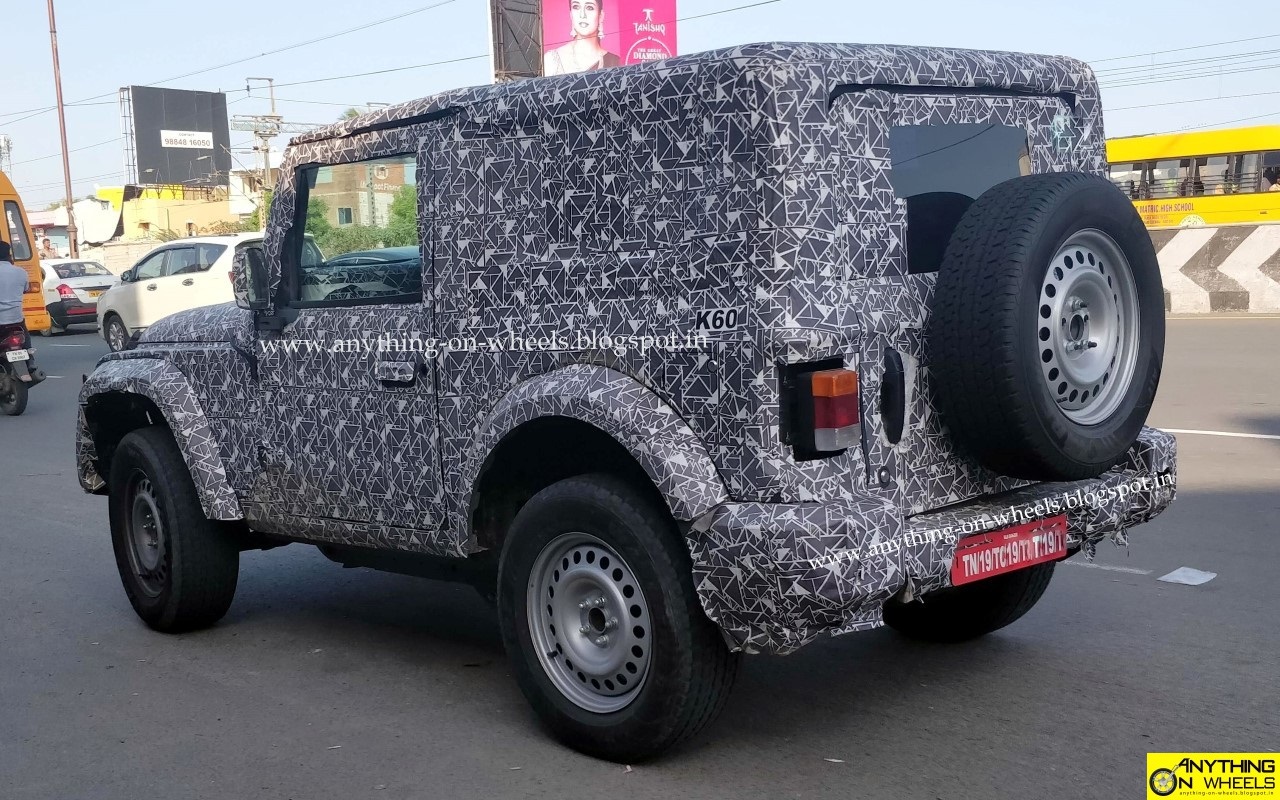
2020 Mahindra Thar spotted testing in Chennai

| Mahindra's lifestyle off-roader is all set for a complete makeover |

| 2020 Thar gets evolutionary styling, thoroughly-updated interiors and a powerful, new engine to go with it's legendary off-roading prowess |

| Factory-fitted hard-top and forward-facing rear seats are finally on offer |

As the saying goes, all good things come to an end. And the end is what the current-generation Mahindra Thar is staring at! Despite its total dominance on the niche it is currently occupying and the relentless love showered on it by its small yet loyal group of followers, the upcoming emission and crash safety norms meant the Nashik-based car-maker had no choice but to upgrade their lifestyle offering. And the smart folks at Mahindra did that in style by retiring the current-generation model with the limited edition Thar 700 that's on sale right now.

Work on the next-generation model is in full swing already, as is evident from these shots that capture a test mule parked by the roadside. Spotted on the busy GST Road in Chennai that also houses the Mahindra Research Valley, the test vehicle was quite an attention grabber. And therein lies Thar's charm! 


With straight lines and boxy proportions that draw more than a passing resemblance to the Jeeps of yore, the all-new Thar is a stunner even with all the camouflage it wears. Up front, the trademark 7-slot grille and round headlights seem to be carried over with little changes. What has changed though are the external hood hinges. The plastic hinges look pleasing in place of those rudimentary metallic ones on the current model. Both the bumpers are all-new as are the fender flares and - wait for it - the factory-fitted hard top (Soft top would be available as an option too). Some old bits, like the front indicators, taillights, rear view mirrors and flap-type door handles, remain but we're guessing Mahindra would be prudent enough to replace them with sleeker units that take up the style quotient by a few notches. 


A quick peep into the cabin revealed that the interiors are getting a much-needed revamp as well. The dashboard and center console were new but unfinished with provision for fitting a touchscreen infotainment system. We can also confirm the presence of a multi-function steering wheel, power windows for the front doors and forward-facing rear seats with seatbelts! Yes, you read that right! It sounds crazy but the Thar on sale in 2019 does not have any of these. Apart from these basic creature comforts, the new Thar would also come with dual front airbags, Anti-lock Braking System with Electronic Brake-force Distribution, seat-belt reminders and a speed-alert system as mandated by the new safety laws. Overall, the new Thar would be a far more comfortable place to be in for the occupants.


The all-new Thar is said to be built on Mahindra's third-gen platform that also underpins models like the Scorpio and TUV3OO. That explains why it appears longer and wider than the current model. Thanks to the upgraded chassis, the suspension setup is changing for the better too with the current Thar's leaf springs making way for an independent suspension. Expect the new Thar to ride plusher, handle tighter and cruise better on highways than the outgoing model. But cruising on highways is not what Thars are made for. Mahindra would not disturb the Thar's legendary off-roading credentials which means the manually-operated four-wheel-drive system with low-range selector and differential locks are likely to be retained.

Under the hood, Mahindra is expected to plonk in a new BS-VI compliant 2.0-liter turbocharged diesel engine that churns out 140 horsepower. That's substantially more powerful than the outgoing model's 2.5-liter CRDe diesel engine and should help the Thar's cause both on- and off-road. A 6-speed manual transmission is likely to be offered. If rumour mills are to be believed, a petrol engine and an automatic transmission could also make their way into the Thar at a later date. 

Mahindra is expected to unveil the all-new Thar at the 2020 Auto Expo with the vehicle going on sale a few months later. If the current Thar with all it's limitations can be as successful as it did, the new Thar - in all likelihood - is going to be a smash hit! Don't expect it to come cheap though.

20190805

Next-gen Audi A6 spotted testing in Pune

| Audi's 5-Series and E-Class rival is all set for a makeover |

| Edgy styling, cutting-edge tech and feature-rich interiors are on the cards |

| More powerful 2.0-liter petrol (45 TFSI) is on the way too |

Brand Audi has become synonymous with luxury SUVs in India, thanks to the undisputed success and popularity of the Q7 and its smaller siblings amongst the elite crowd in the country. But, sedans continue to be a mainstay in the German brand's portfolio just like arch-rivals BMW and Mercedes-Benz. 

With the new 5-Series and E-Class already on sale in India, Audi's A6 is the only mid-size luxury sedan that's at the end of its life cycle. If these spy-shots are anything to go by, that's not going to be the case for long. The all-new, eighth-generation A6 is on it's way here and Audi was caught testing the car in the outskirts of Pune!


As always, Audi has chosen an evolutionary approach when it comes to the new model's design. The new A6 is instantly recognizable as an Audi but looks edgier and sportier for good measure. Be it the sharp new headlights, the re-profiled grille, the swanky taillights or the new rear bumper with fake chrome-tipped exhausts, the new A6 impresses all around. Crucially, the new A6 appears bigger than the current model as well which should help its cause when it comes to the all-important rear seat space and comfort. If the global model is anything to go by, the new A6's interiors will be completely new with a snazzier design, cutting-edge technology and a plethora of features as one would expect from a car in this segment and price range. 


Interestingly, Audi is bringing in a more powerful petrol engine under the hood of the new A6, as evident from the '45 TFSI' badge visible in one of the shots. This nomenclature corresponds to a 2.0-liter, 4-cylinder, turbocharged unit in international markets that generates 245 horsepower and 370 Nm of torque. Mated to a 7-speed dual-clutch automatic transmission, the power is sent to all four wheels through Audi's Quattro all-wheel-drive system. This is a significant step up compared to the 1.8-liter mill in the current A6 that churns out 190 horsepower and sends them to the front wheels only. Those 55 extra horses and additional grip would give the new A6 owners bragging rights over those who own the cheaper A4s and Octavias that share the engine.

The 2.0-liter, 4-cylinder diesel from the current A6 is also expected to join the lineup once the necessary upgrades for making it BS-VI compliant are done.

While the current A6 retails for a little over INR 50 Lakhs, the prices of the new A6 is sure to go up with all the said improvements. Audi is still tight-lipped on the launch date but expect them to bring this as soon as they can if they don't want to continue losing out to their rivals.

20190804

All-new Hyundai i10 caught undergoing pre-launch testing in Chennai

| All-new i10 caught testing in Chennai |

| This is the third-generation of Hyundai's highly-successful hatchback |

| Indian launch is expected towards the end of August |


Hyundai's smash hit, Grand i10, is at the fag end of its life cycle. Launched in 2013, the hatchback - together with the i20 and the Creta - has been the mainstay of the Korean brand's stronghold in India. That the Grand i10 is still a staple in the list of best-selling cars in the country stands testimony to it's popularity and success. 

The upcoming third-generation model, then, has quite big shoes to fill in. Slated for a launch in India later this month followed by it's global debut at the Frankfurt Motor Show in September, the all-new i10 was caught undergoing what should be one of its final rounds of testing in the busy GST Road in Chennai.

While the first-generation i10 was Made-in-India for the world, Hyundai followed a different approach for the car's second-generation. Europe had a smaller version similar in size to it's predecessor while India had a bigger version with a longer wheelbase and a 'Grand' prefix. For the third-generation though, Hyundai appears to be going back to 'one-size-and-shape-fits-all' strategy.


Compare the two test mules featured in the post with the teaser image posted by Hyundai Europe and you will know why. The C-pillar featuring a rising window-line that shrinks and then expands into a wraparound rear windshield hints at an aggressive and stylish makeover hidden beneath the camouflage. Like all new Hyundais, design cues like the cascading grille and wraparound lights are expected to be part of i10's roster. In terms of size, expect the all-new model to be on par with the current Grand i10; that should make it a fairly-spacious urban runabout.


The interiors are likely to undergo a complete makeover as well with all the features and connectivity options we have come to expect in this day and age. Hyundai is likely to retain the 1.2-liter Kappa petrol and the 1.1-liter U2 diesel engines, albeit with both of them upgraded to meet BS-VI emission norms. While the 5-speed manual transmission is likely to be carried over, the archaic 4-speed automatic transmission is rumoured to give way to an in-house developed Automated Manual Transmission. 

With Maruti-Suzuki going all guns blazing with the new Swift, the new i10 can't come any sooner for Hyundai. This battle would be an interesting one to watch!

20190719

MG & Kia make strong debuts in India

| Sales of MG Hector and Kia Seltos are off to a great start |

| Hector bookings cross 21,000 with MG temporarily closing bookings |

| Kia receives over 6,000 bookings for the Seltos in a day |

It's true that the automotive industry in India is going through one of it's toughest phases ever. The mere fact every car-maker out there barring one or two report double-digit drop in sales month-on-month is an indication of the bloodshed that's happening out there. This then is not the right time to enter the market, one would think.

But two brands that most people in India have unheard of are making waves out there, following two different philosophies to penetrate the market. 

Take Morris Garages, for instance. Now owned by SAIC, China's biggest car-maker, MG has been doing everything right ever since they set shop in India. Be it touting their British heritage with nary a hint of their Chinese assocation, be it striking an emotional chord with a small but loyal set of owners of classic MG models, be it their aggressive marketing tactics that kept people talking about the brand or be it the well thought-out maintenance and ownership packages that are designed to alleviate concerns potential customers might have in putting their money on a new brand, MG planned and executed their moves very well.


Backing all these efforts was their product itself, the Hector. Despite being based off a SAIC model, the Hector - endorsed by the popular British actor, Benedict Cumberbatch - never revealed it's Chinese origins which, by the way, isn't a bad thing at all. Indians love bling and MG offered that in dollops with the Hector. Indians crave for features and the vehicle is loaded to the gills and some more with them. With the largest touchscreen ever seen on an automobile in India and next level of connectivity features that's proclaimed with an 'Internet Inside' fender badge, the Hector is tech-savvy, just what the millenials want!

That the Hector's sales crossed 21,000 units within weeks of launch and bookings have been closed until further announcement is a testament to their efforts.

If you're one of those that think MG had an easy way in, thanks to GM's association with SAIC which handed the Halol plant in Gujarat on a platter to MG, what do you have to say about Kia? These folks from South Korea didn't have it easy, despite being closely-knit to Hyundai that has a strong presence and image in India.

From setting up a huge greenfield facility at Anantpur in Andhra Pradesh in record time to counting the days for their first model launch in the country, Indian arm of Kia has put in the 1 Billion Dollars sanctioned by its parent to good use over the last couple of years. The sheer scale shows the commitment and the confidence the brand has in the Indian market. Starting off with an annual capacity to make 100,000 cars, Kia has plans to scale up to 300,000 units a year within two years. Just like Hyundai, Kia has taken along quite a few of it's suppliers and made them set shop close by to solve supply chain constraints.


Though their marketing efforts thus far has been less intense compared to, let's say MG, Kia showed their might at the 2016 Auto Expo. From the Picanto hatchback to the Stinger GT premium sedan, from the Sportage crossover to the Grand Carnival MPV, the Korean brand's 16-strong model lineup brought in for the event left a lasting impression. Taking one of them and adapting it for Indian tastes and requirements would've been the easier option. But Kia didn't do that.

They came up with the Seltos, an all-new model that hits straight at a red-hot segment dominated by Hyundai. Yes, the Creta is what Seltos is aimed at. With it's distinct styling, impressive levels of fit and finish, a gamut of engine and transmission options and bucket-loads of features with many segment-firsts thrown in, the Seltos - based on the SP Signature Concept showcased earlier this year - looks set to usurp it's Hyundai sibling from the throne it currently occupies unchallenged.

Don't believe us? Get this. Bookings for the Seltos opened officially this Tuesday and by the end of the day, Kia had pocketed a whopping 6,000 deposits. And, let's not forget the pricing hasn't been announced yet!

The message then is loud and clear. The sentiments may be down, liquidity might be a problem and lending rates might be on their way up but success is in the offing if car-makers put in earnest efforts and bring in attractive models. 

While it's a great job so far by MG and Kia, the challenge now is to keep the momentum going. It's going to be interesting, let's see how they cope up!

20190713

Hyundai launches the Kona Electric in India

| Kona Electric becomes India's first long-range EV |

| Pan-India introductory ex-showroom price of ₹2,530,000 |

We have had a few full-electric cars launched in India already but they have all had a serious limitation or two that prevented them from being serious contenders. The Reva and it's many siblings were too small, unsafe and impractical. With the same technology underneath, Mahindra Electric's eVerito solved the space issue but it was dated and it's range was limited. Tata's Tigor EV, though modern and safe, is crippled by it's limited range too. Both the Mahindra and the Tata offer a range in the thereabouts of 100 km which does nothing to deter the range anxiety these EVs are notorious for!

In short, Hyundai's Kona Electric - launched in the country earlier this week at a pan-India introductory price of ₹2,530,000 ex-showroom - is India's first proper long-range EV!


With a 39.2 kWh battery that powers an electric motor rated for 134 horsepower and 395 Nm of torque, the Kona Electric is quite powerful. And it's fast too, accelerating from 0 to 100 km/h in 9.7 seconds. Four driving modes - Eco, Eco+, Comfort and Sport are on offer as are paddle shifters to adjust regenrative braking. 

Crucially, the Kona Electric has an ARAI-certified range of 452 km on a single charge. In real-world conditions, expect that number to drop down to about 300 km. The claimed time to recharge the battery to 100% with an AC charger is 6 hours and 10 minutes. With a DC quick charger, the battery can be recharged to 80% of its capacity in just 57 minutes. All Kona customers would be provided with a 7.2 kW charger that can top-up the vehicle's battery withan an hour for a range of 50 km.

The Kona Electric is on sale in 11 Indian cities in select Hyundai dealerships. All of them would be equipped with the aforementioned 7.2 kW AC chargers. That apart, Hyundai has joined hands with Indian Oil Corporation Limited to install a charging network in Delhi, Mumbai, Bengaluru and Chennai. Hyundai is leaving no stone unturned to deter the range anxiety. There will also be a fleet of cars fitted with power converters to provide emergency charging support in these cities. 

The Kona Electric comes with a 3 years / unlimited km warranty with the battery getting a separate 8 years / 160,000 km warranty. That's another concern every EV buyer has ticked off!


With a modern-yet-quirky design language highlighted by the split light clusters at the front and rear, the fake grille-like thing on the fascia, those bulky plastic claddings and the busy profile with multiple cuts and creases, the Kona is an eyeball-grabber. That said, it's a love-it or hate-it affair! Interiors are a typical Hyundai affair with the Kona Electric getting a ton of features and acceptable levels of fit and finish. 


The kit on offer include six airbags, Anti-lock Braking System (ABS) with Electronic Brake-force Distribution (EBD), Electronic Stability Control (ESC), Vehicle Stability Management (VSM), Hill Assist Control, Tire Pressure Monitoring Sytem, electric sunroof, automatic climate control, cruise control, rear-view camera, ventilated and heated leather seats at the front and a 7-inch touchscreen infotainment system with Voice Recognition, Android Auto and Apple CarPlay connectivity options. 

Measuring the scales at 4,180 mm in length, 1,800 mm in width and 1,570 mm in height with a 2,600 mm wheelbase, the Kona Electric is smaller than a Creta. But then, as a high-riding urban SUV boasting it's EV credentials, it makes perfect sense. 

The Kona Electric is modern, safe, practical and offers a long driving range too. Yes, the price appears higher but you'll know it is not when more EVs with similar driving range enter the country. Let's wait and see if the car-buying public out there are convinced.