Showing posts with label Hyundai. Show all posts

20200905

A trio of EV crossovers have started India's electric car revolution

It might take years (or even decades!) before electric cars push over their internal combustion engine counterparts in India but the foundation for that to happen is well and truly set. And a trio of electric crossovers - or SUVs, as some call them - are driving this change.

Tata's Nexon EV, MG's ZS EV and Hyundai's Kona Electric have managed what Mahindra Electric - despite it's 10-year head-start - couldn't. Yes, Mahindra took over the erstwhile Reva Electric Car Company in 2010! Reva, lest you forget, has been around for even longer with Chetan Maini launching his pint-sized toy-ish electric car way back in 2001. What a lead this, to be squandered!

Let's get back to this trio. Their success hinged on their ability to garner the attention of the car-buying public by legitimately staking claim as 'no-compromise' urban run-abouts. That they managed to do it overcoming monumental challenges like lack of charging infrastructure, limited awareness and range anxiety is remarkable.

Look at their spec sheets and you'll know why I called them 'no-compromise' offerings.

The Nexon EV is the most-affordable and consequently the top-seller of this bunch with Tata recently celebrating the roll-out of 1000th Nexon EV. Priced between INR 13.99 - 15.99 Lakhs, the Nexon EV has a 30.2 kWh battery with an ARAI-certified range of 312 km on a single charge. Plugged into a regular 15A socket, the Nexon EV would bump it's battery up from 10 to 90% in 8.5 hours. With CCS2 fast charging, it would take just an hour for the battery to go from 0 to 80%. Even assuming an usable real-world range of just over 200 km, the Nexon EV has hit a sweet spot in the price-range equation. That, along with it's funky looks, class-leading safety and solid build, enhances the Nexon EV's appeal.

The other two are more closely matched and a cut above the Tata, both in terms of pricing and specifications. Surprisingly, it's MG that won against Hyundai's might.

Hot on the heels of Hector's success, MG launched the ZS EV in India with ex-showroom prices ranging between INR 19.88 - 23.58 Lakhs. Equipped with a bigger 44.5 kWh battery and an ARAI-certified range of 340 km, the ZS EV gets multiple charging options. The portable charger that comes along with the car can be plugged into any 15A socket and takes 16-18 hours to juice up the battery from 0 to 80%. The same can be done in 6-8 hours by opting for AC fast chargers and just 50 minutes with DC fast chargers installed in MG dealerships. Road Site Assistance facility for mobile charging support is also available in case of an emergency. The ZS EV's appeal lies in it's all-round capability. Good-looking? Check. Feature-loaded? Double check. Panoramic sunroof? Hell yeah!

That brings us to the Kona Electric, India's first EV crossover and the first-ever EV in the country that offered range in excess of 100 km when it was launched just over a year ago. With a pan-India ex-showroom price of INR 25.30 Lakhs, the Kona Electric has a 39.2 kWh battery with an ARAI-certified range of 452 km. In real-world conditions, that could drop to a little over 300 km, still a mighty impressive number. Time taken to recharge the battery to 100% is a little over 6 hours with an AC charger. Just like MG, Hyundai provides fast-charging DC charges and emergency mobile charging support. It's quirky styling and relatively higher pricing apart, there's nothing quite to fault with the car. The Kona Electric would have sold in higher numbers if MG had not stolen the limelight from the Hyundai within months of it's launch. That the Kona Electric is in high demand globally doesn't help either with allocation to Hyundai India apparently hard to come by.

With all three tasting success, it's clear Indians aren't averse to owning electric cars. Give us an EV that isn't a compromise and were prepared to put our money on it. Hyundai, MG and Tata have effectively ensured other car-makers don't have to think twice to launch their EVs in India. So, who's next then?

20200329

Is Hyundai trying too hard to stand out?

From being a maker of quirky cars for the value-conscious buyers to that of stylish, reliable and feature-loaded cars that are more than a match for highly-regarded Japanese rivals, Hyundai has come a long way over the last decade and half. Words to take note of in that statement are 'quirky' and 'stylish'. That's because design and styling have been the foundation of the Korean brand's transformation in the said period.

With the recent models that are coming out of their gates though, the folks at Hyundai appear to be going back to the old days. Their 'quirky' old days, we mean.

Want proof? Check out the all-new, seventh-generation Elantra that was unveiled at a closed event in Hollywood, California recently.


Hyundai's press release minced no words in stating that the car was deliberately penned with bold design elements that reflect the daring and non-confirming mindset of the next generation. 


In effect, if you're young or young-at-heart, you may think of the new Elantra as a stylish, futuristic-looking automobile that's sure to turn heads on road. Or you may not care at all for what's yet another damn car, like most youngsters do! If you don't belong to one of those two groups, you would categorize the new Elantra anywhere between sharp to brash-looking depending on how you see it.

That's the point, really.

Is Hyundai trying too hard to impress? Are they adding an unnecessary line here and a crease there with the sole intention of making their cars stand out? Have they started rolling out cars that grab attention at launch but will age really fast like most fashion trends do? Most importantly, is all the good work done in transforming the brand's identity being undone?


While answers to those questions will emerge over time, here's the thing. In a span of three generations, the Sonata first and the Elantra now have moved on from the gorgeous-looking sedans they were at the beginning of the decade to the toned-down but still effortlessly elegant cars in-between to the bold, in-your-face models you see now. It's a shame as the current Sonata and the upcoming Elantra look fabulous from certain angles.

Hyundai's crossovers haven't been spared too. From the diminutive Venue to the large Palisade, they are victims of garish grilles and over-styled split light clusters. See what happened to the Creta that's just launched in India and you'll know.

If you're a fan of the current crop of Hyundais, think of this as a rant from an ill-advised auto enthusiast who preaches design conservatism. For the rest of us, there is a collective plea - Bring back the Fluidic Sculptures, Hyundai. Pul-eeezzzz!

20200215

Hyundai Verna facelift caught testing in Chennai

Mid-size sedans might be running out of favour in the crossover-crazy Indian market but these elegant three-boxes aren't going down without a fight. One such model is the Hyundai Verna which has carved a niche for itself in India over three generations. The current model has been especially popular, often challenging Maruti-Suzuki's Ciaz and Honda's City for sales supremacy in the segment. 

Having been on sale in our country since 2017, the Verna is due for a facelift. While China got a controversial, love-it-hate-it design late last year, images of the Russia-bound Solaris facelift (That's how Verna is called there) that Hyundai released earlier this week made us feel better. Much better, in fact!


Now, we can confirm with authority the Verna facelift that's headed here is inspired by the Russia-spec model. Caught testing in Chennai by Mr. Sai Narayan, here are the clearest spy-shots yet of the soon-to-be-launched Verna, hinting at what's in store for us Indians. 


Beneath the camouflage that's now a bit more revealing than before, an outline of Hyundai's trademark 'Cascading Grille' with a diamond-shaped mesh pattern can be seen. At it's top edges, the grille can be noticed merging with a pair of wraparound headlights. Circular fog lights can be seen on the farther edges of the bumper. The profile hasn't changed much except for the shape of the alloys. Changes to the rear appear minimal with the taillights and boot-lid looking like an evolution of the current model.

So, those of you that have been having nightmares imagining the China-spec Verna on our roads can relax now!


With the Bharat Stage-VI norms coming into effect from April, Hyundai is revamping Verna's power-train lineup. All four engines of the current model - 1.4-liter petrol and diesel and 1.6-liter petrol and diesel - are reportedly on the way out, replaced by petrol and diesel engines displacing 1.5 liters. Both manual and automatic transmissions are likely to be paired to these engines. Zoom in on the window sticker and you will notice this car is the top-spec 1.5-liter petrol with a 6-speed manual transmission. 

We wish Hyundai sweetens the deal by offering the 1.4-liter turbocharged petrol engine mated to a 7-speed Dual Clutch Transmission on the flagship variant.

Interiors are likely to get subtle changes as well and, in typical Hyundai fashion, get a plethora of features and creature comforts to keep the occupants happy. Remember, it was the Verna that introduced ventilated seats - an hitherto luxury car feature - to the masses! Expect the South Korean car-maker to continue that tradition.

When it goes on sale shortly, the Verna will face stiff competition from the Ciaz as well as the all-new fifth-generation Honda City. With similarly-priced crossovers out on the kill, this trio's fight to keep the segment alive and ticking is one to watch out for.

20191002

Driven - 2019 Hyundai Venue

Variant Driven: SX CRDi


Compact crossovers have been hot properties in the country ever since Ford's EcoSport burst into the scene in 2013. Over the years, Maruti-Suzuki, Honda, Tata and Mahindra joined the party, grabbing a slice of the ever-growing pie along the way. One biggie conspicuous by its absence in this space was Hyundai. Of course, the Korean car-maker was busy minting money and decimating rivals with the bigger Creta but that doesn't erase the fact that they missed being a part of this crucial segment all along.

In comes the new Venue, trying to make up for lost time with bold looks, plethora of features, a host of engine and transmission options and par-for-the-course pricing. Should the Brezzas and EcoSports out there be worried?

We tell you after driving a SX diesel variant for the better part of a day.

Venue gets Hyundai’s latest and boldest face


Walk up to the car and it’s tough (we mean it!) to focus on anything other than that cheese-grater of a grille. Hyundai’s trademark ‘Cascading Grille’ has become bigger, bolder and - with those ‘in-your-face’ chrome-lined horizontal and vertical slats - screams for attention. That said, it wasn't as intimidating in person as it was when we first looked at the launch images. The rest of the fascia adopts the Korean brand's latest global SUV design language with split lighting clusters that debuted in the current-generation Santa Fe before making its way onto the Kona and Palisade. Venue is the latest to get it with the Tucson next in line.


The thin lenses on top are actually the turn indicators and not Daytime Running Lights as you would've thought. The DRLs are actually positioned below with the headlights and cornering lamps while the fog lamps are placed further down in the bumper. Some might find the LED DRL signature to be too simple, but we think it gives the Venue a distinct identity when it comes up in your rear view mirror. In profile, the Venue is just a mini-Creta. Just like it's bigger sibling, the Venue gets a floating roof effect courtesy blackened A- and B-pillars with the chunky C-pillar and sharply-cut rear doors giving it an aggressive, tipped-forward stance. A strong waist line that runs the full length of the car and mildly-flared sheet metal around the wheel arches look balanced and attractive. The rear, in comparison, is too plain and gives the Venue a hatchback look and feel. The taillights, though, are wonderfully-detailed and look terrific.


Crossovers these days masquerade as SUVs and the Venue is no different. From dual-tone front and rear bumpers with silver inserts and fake skid plates to plastic cladding running the full length of the car, Hyundai's tiny crossover gets everything you look for in SUVs. Roof rails and smartly-designed diamond-cut alloys complete the show.

Hyundai's mastery inside continues

If there is one thing the folks in Hyundai have been consistently at their best over the years, it's in the way they design and put together a new model's interiors. The Venue does no harm to that legacy. 


With a layout that's smart and functional and fit and finish that's second to none in the segment (and even one above) in most places, Hyundai's Brezza-slayer scores a big impression straight away. Sat in the driver's seat, the nicely-contoured steering wheel and the well-designed center console housing those snazzy (but a tad too big) climate control buttons draw your attention. The large air-con vents exude quality and are surrounded by classy brushed silver inserts. The door pads are designed to look like a continuation of the dashboard on either side with the door handles also featuring the same brushed silver effect. The 8.0-inch touchscreen infotainment system, though, could have been integrated better.


The Venue, just like any new Hyundai, comes with an extensive feature list including driver and passenger airbag, Anti-lock Braking System with Electronic Brake-force Distribution, reverse parking sensors with dynamic guidelines, cruise control, ISOFIX mounts, speed alert, automatic headlamps, leather-wrapped steering wheel and gearknob, adjustable front and rear head-rests, 8.0-inch touchscreen infotainment system, climate control and the much-loved electric sunroof. But, it does lose out on goodies like side and curtain airbags, Electronic Stability Control (ESC), Vehicle Stability Management (VSM), Hill Assist Control (HAC), supervision cluster, rear wiper, keyless entry with push button start, wireless phone charger and the Blue Link party trick that are reserved for the top-end SX(O) and SX DCT variants. 

Instrument Cluster:


The SX variant tested loses out on the advanced supervision cluster, yes, but the dials in this car aren't what you would call boring. Featuring a large circular speedometer in the center with the tachometer on the left and LCD display screen on the right, the cluster looks quite interesting with checkered graphics and a pod-like surround. The screen displays all essential information including two trip meters, average fuel efficiency, instantaneous fuel efficiency, distance to empty, average speed and engine running time.

Infotainment System:


Venue's rise to fame has been the much-hyped and super-cool BlueLink platform that comes with an in-built SIM card and a host of connected features. The SX variant loses out on this but the infotainment system on-board has all the features you'll ever need. 

Equipped with four speakers and two tweeters with Arkamys Sound, the system has BlueTooth connectivity, is compatible with Android Auto and Apple CarPlay and is even equipped with Voice Recognition. The 8.0-inch touchscreen is simple to use, fluid to the touch and offers an array of options to customize the car's interiors. The screen doubles up as rear parking display with adaptive guidelines when the reverse gear is engaged. The presence of physical buttons below the touchscreen for all key infotainment functions means you don't have to take your eyes off the road everytime, a thoughtful approach not all manufacturers think of.

Interior quality is top-notch, but not everywhere

As surprised as you may be reading that sub-title, Hyundai's interiors have started showing explicit signs of cost-cutting of late. We highlighted a few in the Santro but that can be excused, considering the car competes in a price-sensitive segment where every Rupee counts. Surprisingly, the Venue's cabin have a few goof-ups too! 

Look at those barren door pads. Made of plastic from top to bottom with nary a soft surface or contrasting element to lay our hands or eyes on, they felt cheap. We may be wrong but even the Santro's door pads felt better. Thank goodness, the SX(O) has a leather-padded armrest. Similarly, the levers to push the backrest and adjust the seat height don't feel sturdy and long-lasting. Come on Hyundai, you have pampered us so much for so long. Why cut corners now when the image is built? 


It's a crossover alright, albeit a diminutive one

Thanks to the huge success of Creta, Hyundai had a tight rope to walk while developing the Venue. Making it as big as some of it's rivals from the segment would eat into Creta's volumes big-time and the Korean car-maker, it seems, wanted a clear visual differentiation of the hierarchy. The result is a crossover that's not as big or as spacious as one would expect.

Forget the car's diminutive dimensions and negligible road presence, the cabin is where things get really congested. The front seats are wide enough and reasonably comfortable for even plus-sized adults. The rear seat, though, is a different story. The legroom is just about sufficient and not what one would call spacious. Forget the spacious Nexon and XUV3OO, the Venue is not even as spacious as an EcoSport. The seat's limited width means making three average-sized adults sit in there is difficult. Add to that the rising window-line and the all-black interiors, the cabin isn't inviting.

Bigger engine and tighter handling would have helped

The trio of engines doing duty under Venue's hood include the familiar 1.2-liter petrol and 1.4-liter diesel with the new entrant in the form of an all-new 1.0-liter turbo petrol. The car we drove was diesel-powered with an engine that's shared with the i20 and lower variants of the Verna and Creta. 


The 4-cylinder mill from the U2 family churns out 89 horsepower and 220 Nm of torque. While those numbers are far from being the best in the segment, Venue doesn't create much of a fuss to keep up with the clan. Thank the car's lesser kerb weight and the engine's minimal turbo-lag for that, with the end result being seamless power delivery in the low- and mid-range. Those are exactly what you need during those long and slow commutes within the city. The Venue doesn't disappoint out on the highway either, if you keep it in the power band. It does struggle at higher revs but then you don't buy a compact diesel crossover to rev high, do you? Mated to a 6-speed manual transmission with a light clutch and short throws, cruising is effortless and the car is quite relaxed and frugal while doing so.


If bragging rights are what you are after, wait for a few months when Hyundai is expected to plonk in a 1.5-liter diesel in the Venue. That should make this little crossover far quicker.


The Venue uses McPherson struts up front and a coupled torsion beam at the rear for suspension duties. Low speed ride quality, like all Hyundais, is compliant with the Venue making light work of the irregularities in the road. There is an underlying firmness to the ride though which makes bigger potholes and manhole covers felt sharply inside the cabin. But, that's never to the point of making the occupants uncomfortable. Handling is well-sorted too with the Venue being composed and mature all the time. Sudden lane changes are done with remarkable poise but remember, this is no EcoSport when it comes to handling. Steering feedback is just so-so despite the fact it weighs up well as speeds increase. Brakes are effective and the Venue sheds speed in a straight line without much drama upon hard braking.


With close to 200 mm ground clearance (Hyundai hasn't published the exact figure), the Venue is tailor-made for our less-than-perfect road conditions. While it can handle those large speed-breakers at ease and that occasional off-road jaunt with some effort, don't forget this ain't an off-roader.

Specifications at a glance


Dimensions

> Length x Width x Height – 3,995 x 1,770 x 1,605 mm
> Wheelbase – 2,500 mm
> Ground Clearance – Not Available
> Fuel Tank Capacity – 45 l

Powertrain

> Configuration – I4
> Displacement – 1,396 cc
> Max. Power – 89 BHP @ 4,000 RPM
> Max. Torque – 220 Nm @ 1,500-2,750 RPM
> Transmission – 6-Speed MT
> Fuel Efficiency – 23.7 km/l 

Other Hardware

> Front Suspension – McPherson Struts
> Rear Suspension – Coupled Torsion Beam Axle
> Front Brake – Disc
> Rear Brake – Drum
> Tyre Size – 215/60 R16

To sum up


At the end of its stint, the Hyundai Venue left us with a lasting impression. That's not because it was the best in one or a few aspects but because it did most things right. Hyundai's baby Creta is not as good as the EcoSport in road manners but it's not bad either. It's not as powerful or as spacious as an XUV3OO but the Venue isn't slow or cramped. The car's price tag isn't as competitive as the Nexon's but it doesn't create an impression of being overpriced. It might not have Brand Honda's pull that's helping the WR-V but Brand Hyundai is as strong, if not more. The car-buying public out there have felt the same too and that's probably why the Venue has become so successful in such a short time frame. So much so, Maruti-Suzuki's runaway best-seller Vitara Brezza is now relegated to the second spot in the sales charts. 

Hyundai, then, has clearly succeeded in making up for the time lost in compact crossover space!


Text & Editing: Aravind Ramesh
Photography: Bharath Rengaraj

20190804

All-new Hyundai i10 caught undergoing pre-launch testing in Chennai

| All-new i10 caught testing in Chennai |

| This is the third-generation of Hyundai's highly-successful hatchback |

| Indian launch is expected towards the end of August |


Hyundai's smash hit, Grand i10, is at the fag end of its life cycle. Launched in 2013, the hatchback - together with the i20 and the Creta - has been the mainstay of the Korean brand's stronghold in India. That the Grand i10 is still a staple in the list of best-selling cars in the country stands testimony to it's popularity and success. 

The upcoming third-generation model, then, has quite big shoes to fill in. Slated for a launch in India later this month followed by it's global debut at the Frankfurt Motor Show in September, the all-new i10 was caught undergoing what should be one of its final rounds of testing in the busy GST Road in Chennai.

While the first-generation i10 was Made-in-India for the world, Hyundai followed a different approach for the car's second-generation. Europe had a smaller version similar in size to it's predecessor while India had a bigger version with a longer wheelbase and a 'Grand' prefix. For the third-generation though, Hyundai appears to be going back to 'one-size-and-shape-fits-all' strategy.


Compare the two test mules featured in the post with the teaser image posted by Hyundai Europe and you will know why. The C-pillar featuring a rising window-line that shrinks and then expands into a wraparound rear windshield hints at an aggressive and stylish makeover hidden beneath the camouflage. Like all new Hyundais, design cues like the cascading grille and wraparound lights are expected to be part of i10's roster. In terms of size, expect the all-new model to be on par with the current Grand i10; that should make it a fairly-spacious urban runabout.


The interiors are likely to undergo a complete makeover as well with all the features and connectivity options we have come to expect in this day and age. Hyundai is likely to retain the 1.2-liter Kappa petrol and the 1.1-liter U2 diesel engines, albeit with both of them upgraded to meet BS-VI emission norms. While the 5-speed manual transmission is likely to be carried over, the archaic 4-speed automatic transmission is rumoured to give way to an in-house developed Automated Manual Transmission. 

With Maruti-Suzuki going all guns blazing with the new Swift, the new i10 can't come any sooner for Hyundai. This battle would be an interesting one to watch!

20190713

Hyundai launches the Kona Electric in India

| Kona Electric becomes India's first long-range EV |

| Pan-India introductory ex-showroom price of ₹2,530,000 |

We have had a few full-electric cars launched in India already but they have all had a serious limitation or two that prevented them from being serious contenders. The Reva and it's many siblings were too small, unsafe and impractical. With the same technology underneath, Mahindra Electric's eVerito solved the space issue but it was dated and it's range was limited. Tata's Tigor EV, though modern and safe, is crippled by it's limited range too. Both the Mahindra and the Tata offer a range in the thereabouts of 100 km which does nothing to deter the range anxiety these EVs are notorious for!

In short, Hyundai's Kona Electric - launched in the country earlier this week at a pan-India introductory price of ₹2,530,000 ex-showroom - is India's first proper long-range EV!


With a 39.2 kWh battery that powers an electric motor rated for 134 horsepower and 395 Nm of torque, the Kona Electric is quite powerful. And it's fast too, accelerating from 0 to 100 km/h in 9.7 seconds. Four driving modes - Eco, Eco+, Comfort and Sport are on offer as are paddle shifters to adjust regenrative braking. 

Crucially, the Kona Electric has an ARAI-certified range of 452 km on a single charge. In real-world conditions, expect that number to drop down to about 300 km. The claimed time to recharge the battery to 100% with an AC charger is 6 hours and 10 minutes. With a DC quick charger, the battery can be recharged to 80% of its capacity in just 57 minutes. All Kona customers would be provided with a 7.2 kW charger that can top-up the vehicle's battery withan an hour for a range of 50 km.

The Kona Electric is on sale in 11 Indian cities in select Hyundai dealerships. All of them would be equipped with the aforementioned 7.2 kW AC chargers. That apart, Hyundai has joined hands with Indian Oil Corporation Limited to install a charging network in Delhi, Mumbai, Bengaluru and Chennai. Hyundai is leaving no stone unturned to deter the range anxiety. There will also be a fleet of cars fitted with power converters to provide emergency charging support in these cities. 

The Kona Electric comes with a 3 years / unlimited km warranty with the battery getting a separate 8 years / 160,000 km warranty. That's another concern every EV buyer has ticked off!


With a modern-yet-quirky design language highlighted by the split light clusters at the front and rear, the fake grille-like thing on the fascia, those bulky plastic claddings and the busy profile with multiple cuts and creases, the Kona is an eyeball-grabber. That said, it's a love-it or hate-it affair! Interiors are a typical Hyundai affair with the Kona Electric getting a ton of features and acceptable levels of fit and finish. 


The kit on offer include six airbags, Anti-lock Braking System (ABS) with Electronic Brake-force Distribution (EBD), Electronic Stability Control (ESC), Vehicle Stability Management (VSM), Hill Assist Control, Tire Pressure Monitoring Sytem, electric sunroof, automatic climate control, cruise control, rear-view camera, ventilated and heated leather seats at the front and a 7-inch touchscreen infotainment system with Voice Recognition, Android Auto and Apple CarPlay connectivity options. 

Measuring the scales at 4,180 mm in length, 1,800 mm in width and 1,570 mm in height with a 2,600 mm wheelbase, the Kona Electric is smaller than a Creta. But then, as a high-riding urban SUV boasting it's EV credentials, it makes perfect sense. 

The Kona Electric is modern, safe, practical and offers a long driving range too. Yes, the price appears higher but you'll know it is not when more EVs with similar driving range enter the country. Let's wait and see if the car-buying public out there are convinced.

20190418

Hyundai unveils the Venue in simultaneous events held in New York and India

South-Korean car-maker Hyundai took the wraps off it's much-awaited compact crossover - the Venue - yesterday. Slotting in below the Kona as the smallest crossover in the lineup, the weirdly-named Venue marks a departure from Hyundai's traditional naming convention for SUVs. For those that do not know, the Kona, Tucson, Santa Fe and Palisade are all named after popular American east coast holiday destinations! 


While the global unveiling took place amidst the glitz and grandeur of the New York Auto Show, the Venue for India was uncovered on-board a cruise ship from Mumbai to Goa. It just goes to show how important the Indian market is for Hyundai in general and the Venue in particular. 

How can it not be? Compact SUVs and crossovers are all the rage these days and every model - from the Ford EcoSport that pioneered the segment to the newest challenger Mahindra XUV3OO - has been successful so far. Of course, Maruti-Suzuki's Vitara Brezza is the runaway sales leader in the pack and the model Hyundai is aiming for with the Venue.


Featuring Hyundai's signature design language first seen on the current Santa Fe, the Venue's fascia is rather striking. The eyeball-grabber, without a doubt, is the Cascading Grille with a checkered chrome mesh. To keep it short, all we can say is it's going to divide opinions. Split light clusters - the latest fad in SUV design circles - give the Venue a strong character that's hard to ignore. From the sides, the Venue looks pretty much like a Creta, albeit a size smaller. At the rear, things are simple and elegant with LED-equipped square-shaped taillights and bold 'VENUE' badging spread across the sculpted tailgate stealing the limelight. 

While the pictures in this post are of the American Venue, the design remains unchanged for India apart from minor detailing differences. It's dimunitive size apart, we got to admit that the Venue is quite a looker!


The interiors - going by the images released - look impressive. A sporty-looking multi-function steering wheel greets the driver while a well-designed and neatly laid-out dashboard look classy. A high-set 8.0-inch touchscreen system, equipped with Hyundai's latest 'Blue Link' connectivity technology that's making it's India debut, occupies prime place in the center. With a total of 33 features - of which 10 are unique for India - spanning safety, vehicle control, location-based services, remote access and voice recognition, the Venue will keep the tech geeks amongst us happy. 

Being a Hyundai, expect the Venue to boast class-leading fit and finish and an extensive feature list.


A 1.2-liter petrol engine generating 83 horsepower and 115 Nm of torque and a 1.4-liter diesel engine churning out 90 horsepower and 220 Nm of torque are the main engine options for India. Both these engines are shared with the popular i20. The petrol comes mated to a 5-speed manual transmission while the diesel gets a 6-speed manual gearbox. For enthusiasts yearning for more, Hyundai is also bringing along a 1.0-liter turbo petrol with 120 horsepower and 172 Nm of torque paired with a 6-speed manual or a 7-speed dual-clutch automatic transmission! 

Globally, a 1.6-liter petrol engine is likely to be Venue's mainstay fitted with a 6-speed manual or an Intelligent Variable transmission.

With the recently-unveiled Palisade expanding Hyundai's SUV lineup at the top, the pint-sized Venue is all set to do the same at the other end. The car goes on sale in India later this month and globally towards the end of the year. Should the Vitara Brezza be concerned? Probably not. Should the EcoSport, Nexon and XUV3OO be worried? Hell, yeah!

20190207

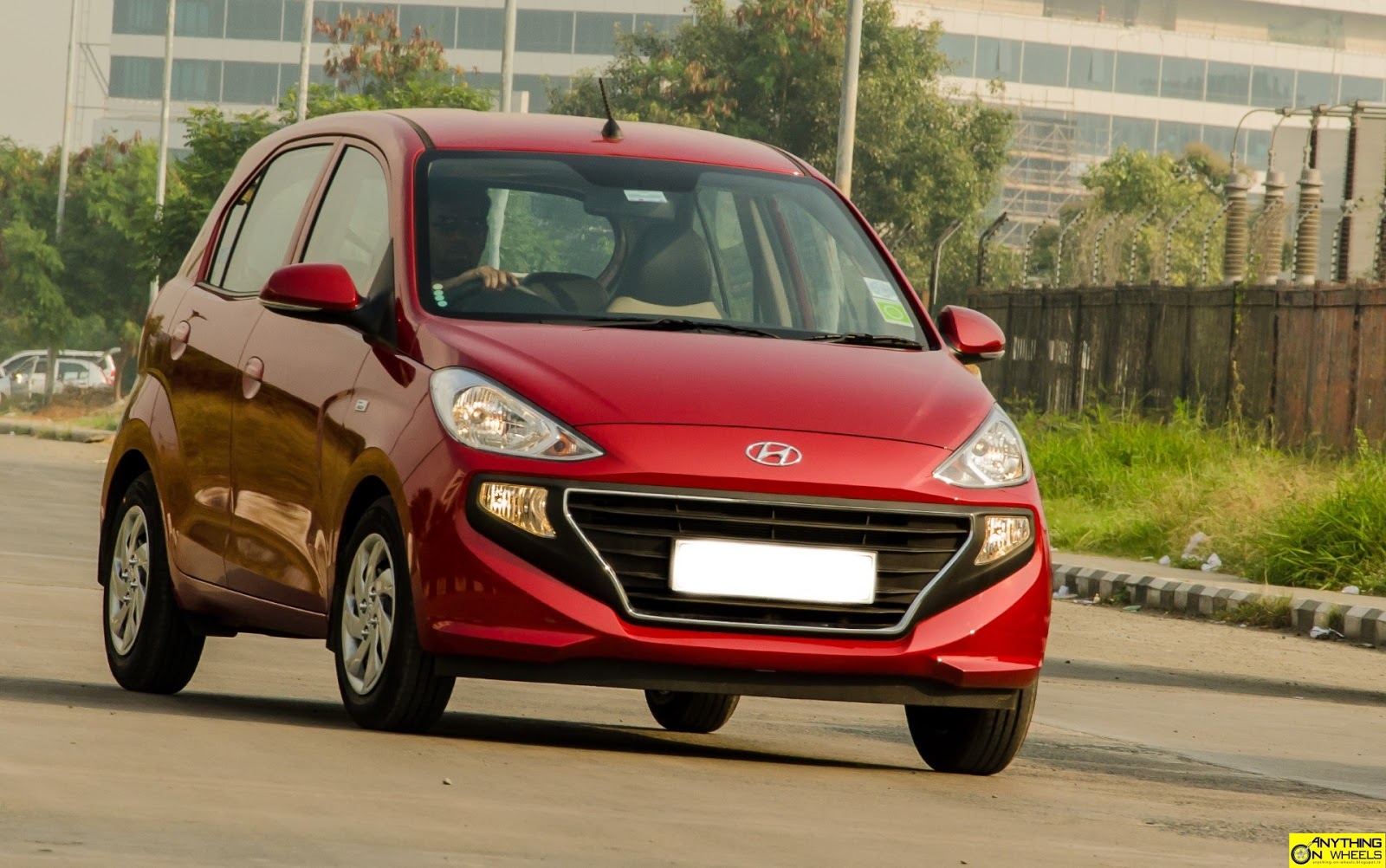
Driven - 2019 Hyundai Santro

Variant Driven: Sportz Auto
​

'Santro' is a name that needs no introduction in India. With 1.32 million out of the total 1.86 million units made finding customers across the country, this was the car that established Hyundai as a popular mainstream car-maker here. So, when Hyundai decided to bring the car back after a four year absence, you know the stakes are high. Does the new Santro meet the expectations? Will it satisfy the thousands of loyal owners waiting to upgrade to a newer and better model? Can it do what the Eon couldn't and take the fight to Maruti-Suzuki? In short, can the new Santro do what it's predecessor did all over again? 

We found out by spending a better part of the day on the top-end automatic variant.   

The Santro is still a quirky-looking car

The original Santro was actually derived from a car the South Koreans know as the Atos. Feedback from customer clinics in India where the car was showcased was apparently so bad Hyundai decided to give the car a nip and tuck along with a new name. Despite getting rid of the van-like rear end, the made-for-India Santro still wasn't a looker. It's bug-eyed headlights, toothy grille, tall-boy proportions and odd-ball derriere made it one quirky little car. 

The all-new Santro continues the tradition and is a fresh and modern take on the quirkiness it's predecessor made popular. 


Up front, high-set wraparound headlights that aren't disimilar to the old i10 give the new Santro a familiar look. A w-i-d-e grille - one that runs the full width of the car - is located right below and makes the car look broader than it actually is. Fog lamps and the registration plate are housed within the confines of the grille. Walk over to the sides and a pair of boomerang-shaped creases scream for attention. In what's a classic case of function being prioritized over form, the window line drops mid-way to make the interiors feel airy and less claustrophobic. Those who prefer clean profiles are likely to be put off with this busy design. At the rear, a pair of small trapezoidal taillights sit on either side of a sculpted hatch. The bumper gets a wide black insert that successfully breaks the monotony and adds a bit of flair.


Clearly, this is a love-it or hate-it design. While the design grew on me by the time I returned the car to it's owner, our photographer felt Hyundai could've done better. After all, the Grand i10 and i20 that share showroom space with the Santro look far more stylish and modern.

Interiors are a treat for the price

When you buy a Hyundai car, you sort of expect quality interiors with fit and finish that rival cars a segment or two higher. With the new Santro, the Korean car-maker has managed to deliver that, yet again. In fact, quality levels in the cabin are so impressive that the Celerio we used as a support car for the shoot felt downright cheap next to the Hyundai. Yes, there's cost cutting and we're getting to that a little later but whatever is in there is nicely put-together and likely to withstand abuse.


The moment you step in, you're bound to be impressed by the well-designed and neatly laid-out dashboard. Hyundai's designers seem to have taken inspiration from a host of places (and cars, obviously) to design this cabin. The two propeller-shaped air-conditioner vents are straight out of an A-Class while the brushed metal inserts on the steering wheel and around the gear lever and the central vents are painted 'Rose Gold' to rival the latest smartphones out there in the market. All the controls fall nicely on hand with the only major ergonomic flaw being the centrally-positioned power window switches. Be it the control stalks, the buttons on the steering wheel, the rotary knobs on the center console or even the re-circulation slider - every one of them is of decent quality and doesn't feel cheap. As always, Hyundai has raised the bar in this segment.


Thanks to the 'Tall Boy' design, the interiors are spacious and practical - two virtues that made the old Santro a smash hit in India. The front seats are soft and supportive and it's quite easy to get to a comfortable position. On the other hand, fixed steering wheel seriously limits the flexibility for the driver. The rear bench is easy to step in and out of and - by virtue of being wider than many of it's rivals - can accommodate three decently-sized adults easily. The seat isn't placed low like some other small cars, so there is decent under-thigh support too. While the floor is almost flat, the first-in-segment rear air-conditioner vents does intrude into the leg space of the fifth passenger. What spoils the show though are the absence of adjustable head restraints. Boot space is decent enough and should have no problems gobbling up a family's average weekend luggage.  

Instrument Cluster: 


As the saying goes, little things here and there make a big difference overall. Santro's instrument cluster fits that statement to the tee. It's a simple unit, yes, but it looks cool and, dare we say, racy. Two overlapping semicircles house a speedometer and a tachometer with an MID screen to the right displaying vital statistics. The irregular outline adds to the visual flair while classy white-on-black fonts are just perfect in terms of visibility.

Read-outs include two trip meters, instantaneous fuel efficiency, average fuel efficiency, distance to empty, engine run time and average speed. 

Infotainment System:


The Sportz and Asta trim levels get a 7.0-inch touchscreen infotainment system with four speakers as standard. Equipped with all sorts of connectivity options like BlueTooth, USB and Aux and capable of supporting Android Auto, Apple CarPlay and Mirror Link, this modern entertainment system is all that you'll ever need. Moreover, the system is intuitive, the display quality is good and there is no lag to the touch.

Apart from the usual entertainment and telephonic options, the touchscreen also serves as a display for the rear parking camera (exclusive to the Asta variant) and lets users customize a host of in-car settings too. While the audio quality is definitely superior to what's being offered by most of the Santro's rivals, we have a feeling the Harman-developed system in the Tiago sounds better. Whether we accept it or not, it's a fact that touchscreens are a source of distraction whilst driving. That's where Hyundai's thoughtful approach of providing physical knobs and buttons for frequently-used functions needs appreciation.    

It's built to a cost.. and that's evident

After all, the Santro is an entry-level hatchback that competes in a highly-competitive and cost-conscious segment where a few thousands make a big difference and affect purchasing decisions. Hyundai had to keep costs in check to have a stab at success in this highly-competitive segment. But, have they gone a bit too far in doing that?

When was the last time you saw a new car sporting outdated flap-type door handles? The Santro, unfortunately, has them. Except Asta, none of the variants get a rear defogger, washer or wiper. Alloy wheels have been given a miss, even on the Asta.


The spree continues inside too. The Santro doesn't get adjustable head restraints; they're not on the front seats and they're not on the rear. That's hard to digest, given it's predecessor had them way back in 1998. That apart, the power window switches placed on the floor console between the front seats, the absence of chrome 'H' logo on the steering wheel, the wheel itself that's not adjustable for reach or rake and the awful slider button for turning the re-circulation mode on indicates the bean counters have had the upper hand. 

Yes, the overall design and ambience of the cabin does make up a bit but that can only take you so far!

The Santro is 'Made in India, for India'

The Santro - or the Atos that it's based on - isn't a globall successful model for Hyundai. With three-fourths of it's sales coming from India alone, it isn't surprising the new Santro was conceived and developed keeping Indian buyer's tastes and preferences in mind. 


For instance, the habit of placing a devotional idol on the dashboard is quite prevalent in India. Hyundai has given a nice and flat dedicated spot for that. Sounds silly, you think? You're wrong, we know of someone who is struggling to find a spot for an idol in his new Innova Crysta's sloping dashboard. The center console, Hyundai claims, is designed to look like an elephant's trunk. Look at it again and you'll realize the resemblance. The first-in-segment rear air-conditioner vents are another example. In a hot and humid country like ours, that makes a huge difference. 


As weird as it looks from outside, that downward kink in the window line helps massively when you're seated in the rear seat. The additional quantity of light that it lets in, together with the beige-and-black seats, makes the interiors feel more airy and spacious than it actually is. 

​An automatic or full safety? Choose one... 


Hyundai's strange strategy of not pairing it's top-end variants with auto transmissions continue with the new Santro. Despite being the top-end automatic variant, our car didn't have an airbag for the front passenger. Only the Asta variant - which doesn't come with an AMT - gets it. None of the other variants, be it manual or automatic, gets one. At a time when there is increased awareness on safety, this is a glaring miss. With Maruti-Suzuki moving the game ahead and Tata piling on the pressure, we expect some feature corrections - and possibly a price correction too - for the Santro very soon.​

You get 4 in a segment full of 3s

​In a segment brimming with cars that fell victim to the 3-cylinder madness​, Hyundai did a 'whiff-of-fresh-air’ moment when it brought in an additional cylinder under the hood of the Santro. What should have been a huge competitive advantage was cut short by Maruti-Suzuki when it launched the all-new Wagon-R last month with both 3- and 4-cylinder engine options. That was out of the blue and Hyundai, we think, wouldn't have expected that. 


​Coming back to the Santro, powering this little hatch is a 1.1-liter 4-cylinder engine from Hyundai's 'Epsilon' series. If that sounds familiar, that's because the same engine powered the old Santro as well as the i10. With a cast-iron cylinder block that has 3-valves per cylinder, this is an old-school motor - albeit with the addition of variable valve timing for improved power and fuel efficiency. Delivering 68 horsepower at 4,500 rpm and 99 Nm of torque at 5,500 rpm, the Santro settles well in the middle of the pack when it comes to power and torque figures.


Turn the key on and the benefits of an additional cylinder is immediately felt. Santro’s refinement at idle as well as in motion is impressive. Get going and the car responds with a gradual build-up of pace. Within the confines of the city, this little Hyundai will have no problems in keeping up with traffic. Those who have driven the old Santro would know that car was the king of the urban jungle, thanks to it's superb low-end torque and peppy nature. The new Santro, sadly, isn't the same. The low-end response is just adequate but the car redeems itself by coming to life once the needle crosses 2,000 rpm. An impressive mid-range and linear power delivery makes the Santro enjoyable within the confines of the city. And while doing so, the fuel efficiency is pretty good too. If you're an i10 automatic owner, you will be genuinely surprised by how efficient this wannabe automatic Hyundai is!


Give it the beans out on a highway and the motor comes short. This isn't an engine that likes revving closer to the red line. It sounds strained and it doesn't reward you for all that noise it generates. 

Yippee, finally there is an AMT that isn't jerky!


As mentioned before, the car we drove was paired to an Automated Manual Transmission that Hyundai calls 'Smart Auto'. And smart it is, given this unit has none of the jerky nature that AMTs in general and the ones from Maruti-Suzuki and Tata in particular are known for. No, this isn't as smooth as a conventional automatic gearbox or a Continuously Variable Transmission (CVT). But, for what is Hyundai's first-ever AMT and that too an in-house developed unit, this is quite a triumph. You do feel the shifts in lower gears and things get progressively smoother as you hit higher gears. With the upshifts happening early, it's clear Hyundai has tuned the unit for better fuel efficiency. But you can bypass that by pressing the throttle pedal hard. The car holds its gear until you hit 6,000 rpm before going up a ratio. 


For those looking for some action to their left hand, there is a manual mode as well. Slot the stick in 'D' and move it right to engage. Push the stick up to upshift and pull it down to come down a gear ratio. It's definitely more engaging to drive this way but then it beats the purpose of buying a car equipped with an AMT. Overall, for those looking for a stress-free and jerk-free drive in urban confines, we would recommend the Santro Smart Auto without hesitation. 

Ride and handling are par for the course


Despite being a strong package, old Santro's 'Achilles Heel' was it's bumpy low-speed ride quality. We are glad to tell you Hyundai has rectified that in the new Santro. With a McPherson strut up front and a coupled torsion beam setup at the rear, the suspension hardware is standard fare. Thanks to comfort-oriented tuning, the ride quality is absorbent and bumps and potholes are taken care of well at slow and medium speeds. At high speeds, you do feel the road irregularities more. Thankfully, the improvement in ride doesn't come at the expense of handling. The new Santro handles much better than it's predecessor too. Body roll is well controlled despite the car's height and it doesn't scare you during sudden lane changes. But then, let's not forget this isn't a point-and-shoot kind of enthusiast's car.


Specifications at a glance


Dimensions

> Length x Width x Height – 3,610 x 1,645 x 1,560 mm
> Wheelbase – 2,400 mm
> Ground Clearance – 165 mm
> Fuel Tank Capacity – 35 l


Powertrain

> Configuration – I4
> Displacement – 1,086 cc
> Max. Power – 68 BHP @ 5,500 RPM
> Max. Torque – 99 Nm @ 4,500 RPM
> Transmission – Smart Auto AMT
> Fuel Efficiency – 20.3 km/l


Other Hardware

> Front Suspension – McPherson Strut
> Rear Suspension – Coupled Torsion Beam Axle
> Front Brake – Disc
> Rear Brake – Drum
> Tyre Size – 165/70 R14


To sum up


After having spent the better part of a day with the car, it's hard not to be impressed with the new Santro. Here is an entry-level hatch that doesn't feel cheap. Hyundai's little car not only gets us a tight build, high-quality interiors and a slew of segment-first features but also an extremely-refined engine paired to a smooth AMT (if we can call one that!). Sure, there are some glaring misses like the absence of a passenger airbag across the range and the quirky styling but this is one car you can't go wrong with. 

Problem is, Maruti-Suzuki sensed it before any of us could and the new Wagon-R is their answer. The Santro will have it's task cut out against it's arch-rival!


Text & Editing: Aravind Ramesh
Photography: Bharath Rengaraj