20131010

Nissan launches Terrano, positions it above the Duster


Nissan India announced the launch of Terrano, its premium compact Sports Utility Vehicle, yesterday. Over the last few months, Nissan kept the media busy by first revealing the name of the model along with an official sketch followed by an unveiling before opening the pre-launch bookings last month. Despite the Terrano being a rebadged and redesigned Renault Duster, Nissan also took time to test the Terrano on public roads, with the test vehicle even featuring on our blog once. All those efforts have paid off, with Nissan already sitting on an order book of 6000 units for the Terrano. The fact that so many Indians were ready to put their money on the Terrano even before it's prices were announced just goes to show the craze that our country has for utility vehicles.

In line with the pricing policy followed by the Renault-Nissan Alliance in which the donor model is cheaper, the Terrano is priced higher than its sibling, the popular Renault Duster. In keeping with the market demand, the Terrano is launched in one petrol and six diesel variants. While the petrol variant is powered by a 1.6-liter engine with 104 PS of maximum power, the diesel variants have the same 1.5-liter dCi engine in two states of tune with power outputs of 85 PS and 110 PS.


The petrol variant retails for INR 9.79 Lakhs. The 85 PS diesel variants are priced between INR 9.59 and 10.94 Lakhs, while the 110 PS diesel variants retail between INR 11.33 and 12.46 Lakhs. All prices are ex-showroom, New Delhi.

The best thing about the Terrano is that Nissan has went that extra mile to ensure that its compact SUV is quite different from the Duster. Up front, Nissan has neatly integrated its family look that we have seen and liked in models like the Pathfinder and Patrol. The four-pod headlights along with the three-part radiator grille with twin chrome bars look impressive. Nothing much changes in the profile with the massive wheel arches lending the Terrano a butch stance. In the rear, new taillight lenses complete the makeover. The changes continue inside too, with a redesigned center console and air-conditioner vents lending the cabin a fresh and upmarket look.


Right from the Micra, Nissan has left us impressed with its no-compromise approach on safety and the Terrano is no different. The Driver Airbag is standard across the range, while the higher variants offer Antilock Braking System (ABS), Electronic Brake-force Distribution (EBD) and Brake Assist (BA). The top-of-the-line XV Premium variant comes with Bluetooth-enabled audio system, rear air-conditioning vents, leather upholstery, wood finish in door trims, reverse parking sensors and 16-inch machined alloy wheels. While all this is good, the Ford Ecosport trumps the Terrano in terms of features on offer. That's probably why things like touchscreen entertainment system with navigation, steering-mounted audio control module and rear parking sensors with display in rear view mirror are available as part of a big list of official accessories right from launch.

The debut of Nissan Terrano makes it two rebadged models launched in the Indian market in two days. Overall, this is the fourth rebadged model from the two joint ventures between Renault, Nissan and Ashok Leyland. With the Ford Ecosport giving the Renault Duster a run for its money, the Nissan Terrano, with its premium positioning, has its work cut out. Looking at the initial response though, Nissan seems to have done well in the litmus test.

Ashok Leyland launches Stile, a rebadged Nissan Evalia


Thanks to the Renault-Nissan Alliance, Indians are now familiar with the concept of 'badge-engineering', a diplomatic definition of denoting new models that are nothing but re-badged variants of an existing model. Ashok Leyland, Nissan's Indian partner for Light Commercial Vehicles, joined the party with the launch of its Stile Multi-Purpose Vehicle earlier this week. Following its debut at the 2012 Auto Expo in New Delhi and the formal unveiling in the presence of Mr. Carlos Ghosn, CEO of Renault-Nissan Alliance, the Ashok Leyland Stile was officially launched this Monday at an event held in New Delhi. M.S.Dhoni, India's cricketing sensation and Ashok Leyland's brand ambassador was present for the launch.

Don't be deceived by it's name. The Stile is nothing but a re-badged and a subtly redesigned Nissan Evalia. While the Evalia, amidst expectations that it would put an end to Toyota Innova's dominance, failed spectacularly in our market, Ashok Leyland (and Nissan too) would be hoping that the Stile hits the sweet spot. The most prominent change in the Stile is its grille and the headlights, that are quite different from the Evalia. While the profile remains unchanged, the Stile gets sliding rear windows that was absent in the Evalia. At the back, the reflector strips aimed at reducing the visual bulk of the Evalia are done away with. The Stile isn't unattractive, but not what we would call attractive either.


Ashok Leyland has made it clear that the Stile is targeted at the commercial segment that includes applications such as taxis, hotel shuttles, ambulances, parcel vans and courier services. Available in 7 and 8-seater configurations with the popular 1.5-liter K9K diesel engine under the hood, the Stile has just what it takes to succeed. Air-conditioning, power steering, seat belts for all three rows and tilt-steering are standard across the range while the top-spec variant can be bought with features such as rear air-conditioning vents, captain seats in the second row, central locking, front power windows and a silver-finish center console. Safety features have been given a miss, with ABS, EBD and Airbags not available on any variant.

With prices starting at INR 7.49 Lakhs for the base LE variant and going up to INR 9.29 Lakhs for the top-end LX variant with optional alloy wheels, the Stile is significantly cheaper than the Evalia. Will this make the difference between the two cars and help the Stile succeed? Looking at the success of Dost, the first product of the Ashok Leyland-Nissan LCV joint-venture and the way in which the Stile is positioned purely targeting the commercial segment, we don't see a reason for it to fail.

20131005

Travelogue #11 - Chennai to Mahabalipuram


India might not fare well in modern architecture but our country, in ages gone by, undoubtedly possessed the best of everything. Mahabalipuram, also called Mamallapuram, is a feel-good destination that not only proves that point but also makes us proud of our legacy. Famous for its magnificent structures carved and cut out of huge rocks that are spread over a few square kilometers adjacent to the Bay of Bengal on the east coast of India south of Chennai, the monuments of Mahabalipuram are declared a "World Heritage Site" by UNESCO. And quite deservedly so, if we are eligible to say that.

It's not without reason Mahabalipuram is one of the most popular destinations in India for tourists from other countries. The moment you venture left off the ECR, this historic town mesmerizes with its grandeur and splendor. Believed to be built between the 7th and 9th centuries by the Pallava dynasty who ruled this part of the country, Mahabalipuram is a symbol of beauty and a shining example of the architectural skills of our great ancestors. It's a pity then, that we depend on architects from other countries for building our cities these days.

The Shore Temple, by far the most popular monument in Mahabalipuram, is a majestic structure that stands tall adjacent to the sea. Being a structural stone temple built out of blocks of granite, the Shore Temple is different from the other monuments in the town that are rock-cut. It's not uncommon to hear instances of the ocean waves crashing on the temple walls during high tides. This continuous hammering for centuries has slowly eroded the structure, which is evident from the smoothened and blunt surfaces that have lost definition. A recent exploration off the coast of Mahabalipuram has uncovered remains of similar temple complexes under water, hinting that the "seven pagodas", as ancient European explorers apparently called Mahabalipuram referring to the seven structures, is not just a myth.

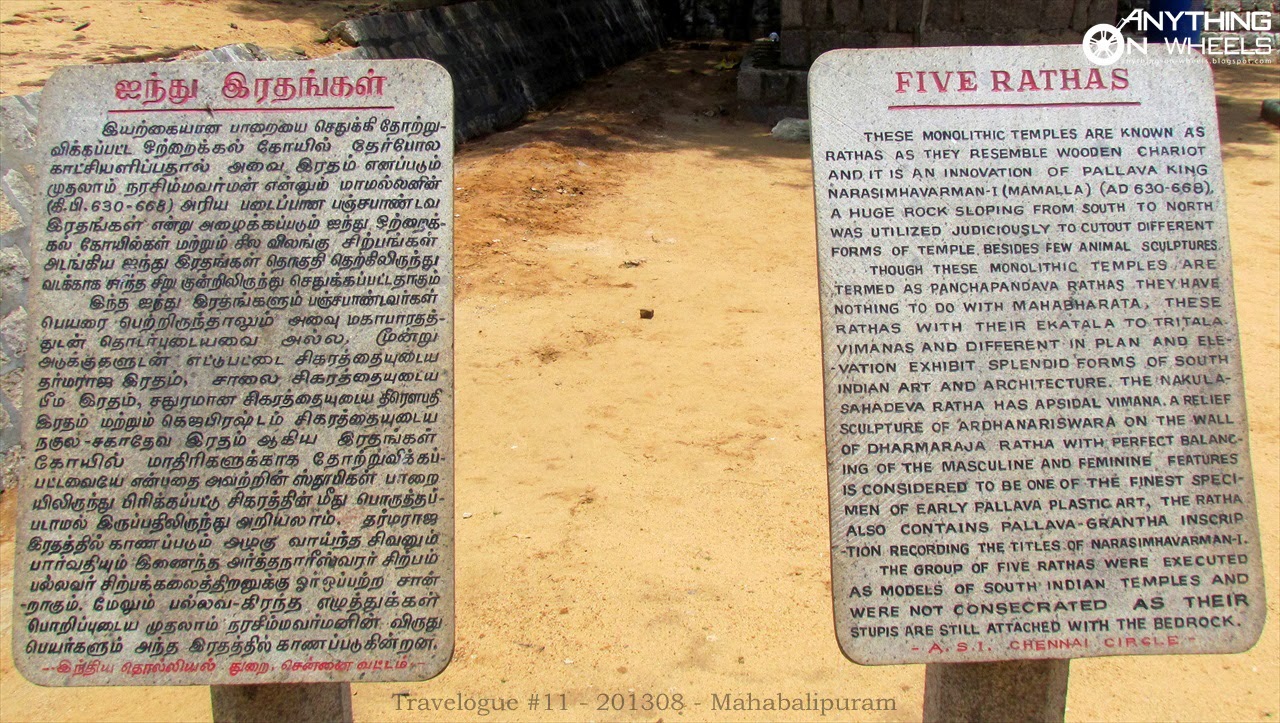
The Pancha Rathas, which means 'five chariots' in English, is yet another must-see destination in Mahabalipuram. Each of the five rathas are made out of a single stone and are named after the Mahabaratha fame Pancha Pandavas and their wife Draupati. It is believed that these rathas are incomplete and have no connection with the epic Mahabaratha, despite carrying those names. Whatever it is, the five rathas are a sight to behold and, quite understandably, is one of the 'most photographed' structures in India. Walk across the road and enter the commercial complex that's lined up with small shops that sell colorful stone-made items and souvenirs.   

Between the Shore Temple and the Pancha Rathas is the Descent of the Ganges or Arjuna's Penance, a huge, glorious, open-air bas-relief that has a crevice at the center intended to depict the descent of the river Ganges to Earth. Another interpretation is that the figure standing on one leg in the structure is that of Arjuna who is performing a tapas to receive a boon from Lord Shiva. A total of 146 carvings including scores of gods, goddesses, mythical figures and animals are immortalized in this structure. The life-size carvings of elephants in this monument are one of Mahabalipuram's post-card images and considered to be amongst the best animal carvings in India.

Just behind the Descent of Ganges is a big complex that has a series of intricately carved caves. Mandapams, as they are called in Tamil, are pillared structures that are cut into rocks, giving the impression of a cave. Varaha Caves, Rayar Gopuram, Ramanuja Mandapam, Ganesha Ratha and a huge stone called 'Krishna's Butterball' that's perched precariously over an open rocky hillock are all interesting and attractive in their own ways. The Light House and Mahishasuramardhini Mandapam inside the same complex are very popular monuments for the awesome views that they offer and get really crowded on weekends.

Unlike many other tourist destinations, Mahabalipuram is at its best when the sun is shining hot. The sunlight brings out the glory of these monuments spectacularly, as is evident from the images posted below. But, there is a flip side to it. The ruthless Chennai weather drowns your energy levels, so much so, you get tired after just a couple of hours. Don't get bogged down though. The beauty and sheer magnificence of these monuments will keep you in a high.

Following in the footsteps of our previous travelogues that took us to Puducherry and Pitchavaram, Mahabalipuram is the third beautiful destination in the East Coast Road. We have made no secret of the fact that we love the ECR and never miss an opportunity to drive along this scenic two-lane highway that runs parallel to the coast. And every time we go there, the road reminds us to stay alert, drive within the limits and get back home with the widest possible grin. This time, it was a toppled Mahindra Scorpio that gave us a grim reminder of what the ECR is capable of doing.

ROUTEMAP:


FACTFILE:

* Total No of Days: 1 (18.08.2013)
* Vehicle Make & Model: Honda Civic

* Odometer Start Reading: 53064 km
* Odometer End Reading: 53196 km
* Total Distance traveled: 132 km
* No of Toll Booths: 2
* Money spent on Toll & Parking: Rs. 118

* Total Quantity of Fuel filled: 12.84 l
* Average Fuel Consumption: 10.28 km/l
* Money spent on Fuel: Rs. 958

* Destinations Covered: Mahabalipuram
* Route Followed: Chennai-Sholinganallur-Mahabalipuram

THE LANDSCAPE:


THE AUTOMOBILE:


Despite visiting this coastal town atleast a couple of times in the recent past, this was the first time we managed to cover its complete grandeur on a single day. Needless to say, it's an experience that is going to stay in our minds forever! Anything On Wheels is here to stay. So, stop staring at this post now and start planning your trip to Mahabalipuram. And if you happen to be in Chennai, all you need is a moisturizer tube and a sun-glass to head out!

20131004

The all-new Bentley Flying Spur goes on sale in India


Of late, India’s uber-rich clientele, a small but rapidly expanding group with potential to multiply in the not so distant future, is turning out to be a lucrative market for global luxury-car manufacturers. That is what is pushing brands as diverse as Rolls-Royce and Koenigsegg to establish a strong foothold in the Indian market. Bentley is no exception. Delhi-based Exclusive Motors is the official dealer representing and retailing the automobiles crafted at Bentley’s facility in Crewe, England.

The all-new Flying Spur that made its global debut earlier this year is now officially on sale in India, joining a lineup that includes the popular Continental series. Retailing at INR 3.10 Crores, the Bentley Flying Spur has no competition except for the Rolls-Royce Ghost, that retails at similar prices and targets the same set of customers.


For us, the Flying Spur has always been one of the finest looking sedans ever made and the new model does nothing to change that opinion. As with most high-end automobiles these days, the lights are the center of attraction in the Flying Spur. While the twin circular lights complement the massive radiator grille up front, the elliptical taillights ensure that the Flying Spur looks majestic from all angles.

Available in four and five-seat configurations, the interiors of the Flying Spur, like all other Bentleys, are handcrafted from the finest quality of leather, wood and chrome. With every possible creature comfort and safety feature on offer, the new Flying Spur’s center of attraction is a touchscreen controller at the rear that’s capable of controlling everything from the seats and air-conditioning to the multimedia entertainment and navigation system.


With a 6-liter twin turbocharged W12 engine powering all four wheels, the Flying Spur boasts a maximum power of 616 bhp and a peak torque of 800 Nm. Those figures are nothing short of mind-boggling and are capable of pulling the Flying Spur from 0 to 100 km/h in just 4.6 seconds to a top-speed of 322 km/h. We wish India had the roads where this monster could be unleashed.

In any case, for those who can afford it, the new Bentley Flying Spur offers a compelling combination of luxury, speed, style, image and practicality that's hard to resist.

20131003

Skoda relaunches 'Octavia' nameplate in India

The first-generation Octavia was a surprise hit for Skoda, an hitherto unheard brand in India. Coming in at a time when premium cars from new brands failed to make an impact in the conservative Indian mindset, the Octavia broke the notions associated with our market. Playing the cards of good value for money and excellent fuel-efficiency, two virtues that Indians crave for, the Octavia hit the sweet spot and firmly established Skoda as a luxury brand in India. The Octavia was such a big hit that Skoda continued to sell the car alongside the second-generation model that was unimaginatively named as Laura.


With the launch of the third-generation model today, the Octavia nameplate is making a comeback in India after an absence of three odd years. Skoda is betting big on this model, which is evident from the fact that the new Octavia is available in three trim levels (Active, Ambition and Elegance) with a mix of three engine and three transmission options.

The Active and Ambition variants are powered by the 1.4-liter TSI engine that produces 140 PS of maximum power and 250 Nm of peak torque. The top-end petrol variant Elegance is more powerful with 180 PS of maximum power, thanks to the 1.8-liter TSI engine that's mated to a 7-speed DSG dual-clutch automatic transmission. The diesel variants are powered by the familiar 2.0-liter TDI engine that belts out 143 PS of power and 320 Nm of torque. While the base Active variant comes only with a manual transmission and the top-end Elegance variant comes only with a 6-speed DSG automatic transmission, the Ambition variant comes with a choice of either of these transmissions.


Prices for the petrol variants are INR 13.95 Lakhs (Active), 14.95 Lakhs (Ambition) and 18.25 Lakhs (Elegance). The diesel variants retail for INR 15.55 Lakhs (Active), 16.55 Lakhs (Ambition), 17.55 Lakhs (Ambition AT) and 19.45 Lakhs (Elegance). All prices are ex-showroom Delhi. At these prices, the Skoda Octavia is no longer the segment benchmark for value for money as it once used to be. In fact, the new Octavia is more expensive than the Volkswagen Jetta, which is surprising given the fact that Volkswagen is positioned as a premium brand in India.

To justify its pricing, Skoda has kitted the Octavia decently. Antilock Braking System (ABS), dual airbags, 16-inch alloy wheels, power mirrors, power windows, traction control, driver's seat height adjust, steering adjust, remote locking and rear air-conditioner vents are standard across the range. The flagship Elegance variant is fully loaded and boasts bi-xenon headlamps, six airbags, stability control, panoramic sunroof, cruise control, an electronic differential lock for the front axle, a touchscreen audio system with steering-mounted controls, dual zone climate control, stability control, multi-collision braking system that automatically stops the car if the driver's foot is off the brake pedal after a crash and automatic headlamps and wipers amongst other features.


Based on Volkswagen group's popular 'MQB' platform that spans a host of models in as much as four brands, the new Octavia boasts solid underpinnings.

It was the Octavia's reach that established Skoda as a luxury brand in India, quite contrary to it's budget image in rest of the world. With the launch of the all-new Octavia, Skoda is trying to capitalize on the image and legacy of the old model. Will the Octavia do what the Jetta couldn't and dethrone Hyundai Elantra from the top? Let the game begin.