20131013

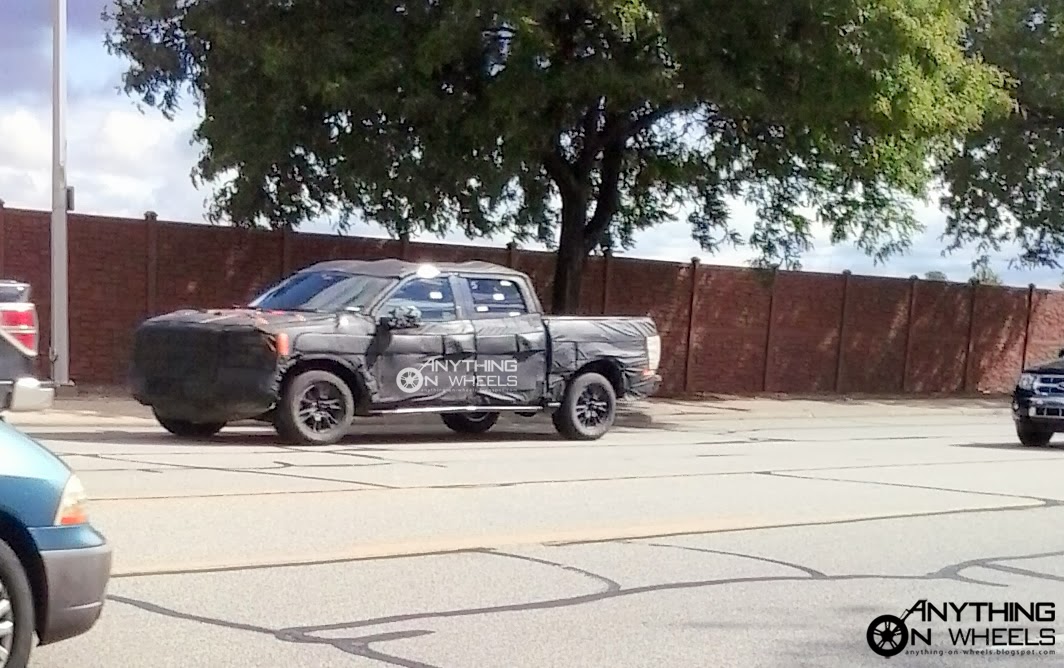
Next-generation Ford F150 spotted testing

The Ford F150 pick-up enjoys a chequered history. For more than three decades, the F-Series, the collective nomenclature used to denote Ford's full size pick-up trucks in which the F150 is the most popular model, has been the largest selling automobile in the United States of America. Inspite of stern challenges and several scares in the past, neither the Silverados, Rams and Sierras nor the Camrys, Accords and Altimas could dethrone the F-Series from the top of the sales charts. The sheer dominance of the F-Series and the fat profit margins that are generally associated with such trucks means that this model contributes significantly to Ford Motor Company's bottom-line.


When such an important model is due for a change, the entire automotive fraternity takes note. One such moment occurred at the 2013 International Auto Show in Detroit earlier this year. The Atlas Concept that made its debut at the show was the precursor to the next-generation F150 that is slated to go on sale sometime next year. Those vertically-stacked headlights, that massive grille with its unique vertical vents at the two ends, those flared wheel arches and that suave detailing in the quad-LED taillights did create a lasting impact that was quite unusual for a truck.


So, when this camouflaged truck whizzed past in the opposite direction in one of the suburbs of Detroit, our reader didn't have trouble identifying the model. Yes, the integration of headlights and taillights in the test vehicle matches the size, shape and location of the lights in the Atlas Concept. The outline of the massive grille that was a show-stealer at the Detroit Motor Show can be traced behind the canvas as well. But, the muscular crease and the flared wheel arches that adorned the profile of the Atlas Concept is nowhere to be seen in the test vehicle. Whether this is clever masking by Ford or one of those many instances where nice design touches gets lost in the transformation from concept to production stage remains to be seen.

The next-generation Ford F150 is said to be focusing on shedding its weight and improving its fuel-efficiency for meeting the CAFE standards that's getting stricter with each passing year. A combination of Ford's award-winning 'EcoBoost' engine, several tech features like active shutters in the grille and wheels that closes automatically when not needed to be open, stop-start system and aluminium body components are said to be aiding the company in achieving its mission. One thing that's certain is, when this next-generation F150 goes on sale, expect it to give the competition a run for their money.

20131012

Grand i10 rakes in more than 10,000 bookings, but Hyundai isn't done with the testing yet

There are certain things about Hyundai that doesn't fail to impress us. Despite being the largest car exporter out of India and second only to Maruti-Suzuki in domestic sales, the company is targeting further growth and continue to launch models across all segments of the passenger car industry. Between the Santro, Eon, i10 and i20, Hyundai's small cars hold the second largest share after Maruti-Suzuki's lineup of six small cars. The Verna leads the mid-size segment in sales while the Elantra does the same in the premium midsize segment. A major attribute that helped Hyundai achieve such a big success in India is coming out in the Grand i10 episode, Hyundai's newest entrant in small car segment.

The Grand i10 is hardly a month old in the Indian market. Within this time-span, Hyundai received a colossal 100,000 enquiries for the car of which more than 10,000 odd were apparently converted into confirmed orders. But Hyundai, being who they are, isn't resting on it's laurels. Instead of basking on the success of the Grand i10, Hyundai India continues to test the car in and around Chennai where the company's manufacturing facility is located.


So, what's cooking in this test car? We know that Hyundai is about to launch an automatic transmission variant of the Grand i10 in a few months, powered by the peppy 1.2-liter Kappa2 engine. It could be the auto tranny that's being given a workout here. But then, the test car with its steel wheels sans wheel covers hints at the base variant. So, is Hyundai readying a new base variant to go below the existing 'Era' variant? We don't know yet. On the contrary, this car could just be part of an endurance run of the Grand i10 with no new parts or components being tested. Anyway, if the test car was without the partial camouflage that it had, we wouldn't have even noticed it thanks to a healthy number of Grand i10s roaming around in Chennai already.


Whatever it is, Hyundai's relentless commitment and focus comes out to the fore here. This will all but ensure that the grand run of the Grand i10 is here to stay!

20131010

Nissan launches Terrano, positions it above the Duster


Nissan India announced the launch of Terrano, its premium compact Sports Utility Vehicle, yesterday. Over the last few months, Nissan kept the media busy by first revealing the name of the model along with an official sketch followed by an unveiling before opening the pre-launch bookings last month. Despite the Terrano being a rebadged and redesigned Renault Duster, Nissan also took time to test the Terrano on public roads, with the test vehicle even featuring on our blog once. All those efforts have paid off, with Nissan already sitting on an order book of 6000 units for the Terrano. The fact that so many Indians were ready to put their money on the Terrano even before it's prices were announced just goes to show the craze that our country has for utility vehicles.

In line with the pricing policy followed by the Renault-Nissan Alliance in which the donor model is cheaper, the Terrano is priced higher than its sibling, the popular Renault Duster. In keeping with the market demand, the Terrano is launched in one petrol and six diesel variants. While the petrol variant is powered by a 1.6-liter engine with 104 PS of maximum power, the diesel variants have the same 1.5-liter dCi engine in two states of tune with power outputs of 85 PS and 110 PS.


The petrol variant retails for INR 9.79 Lakhs. The 85 PS diesel variants are priced between INR 9.59 and 10.94 Lakhs, while the 110 PS diesel variants retail between INR 11.33 and 12.46 Lakhs. All prices are ex-showroom, New Delhi.

The best thing about the Terrano is that Nissan has went that extra mile to ensure that its compact SUV is quite different from the Duster. Up front, Nissan has neatly integrated its family look that we have seen and liked in models like the Pathfinder and Patrol. The four-pod headlights along with the three-part radiator grille with twin chrome bars look impressive. Nothing much changes in the profile with the massive wheel arches lending the Terrano a butch stance. In the rear, new taillight lenses complete the makeover. The changes continue inside too, with a redesigned center console and air-conditioner vents lending the cabin a fresh and upmarket look.


Right from the Micra, Nissan has left us impressed with its no-compromise approach on safety and the Terrano is no different. The Driver Airbag is standard across the range, while the higher variants offer Antilock Braking System (ABS), Electronic Brake-force Distribution (EBD) and Brake Assist (BA). The top-of-the-line XV Premium variant comes with Bluetooth-enabled audio system, rear air-conditioning vents, leather upholstery, wood finish in door trims, reverse parking sensors and 16-inch machined alloy wheels. While all this is good, the Ford Ecosport trumps the Terrano in terms of features on offer. That's probably why things like touchscreen entertainment system with navigation, steering-mounted audio control module and rear parking sensors with display in rear view mirror are available as part of a big list of official accessories right from launch.

The debut of Nissan Terrano makes it two rebadged models launched in the Indian market in two days. Overall, this is the fourth rebadged model from the two joint ventures between Renault, Nissan and Ashok Leyland. With the Ford Ecosport giving the Renault Duster a run for its money, the Nissan Terrano, with its premium positioning, has its work cut out. Looking at the initial response though, Nissan seems to have done well in the litmus test.

Ashok Leyland launches Stile, a rebadged Nissan Evalia


Thanks to the Renault-Nissan Alliance, Indians are now familiar with the concept of 'badge-engineering', a diplomatic definition of denoting new models that are nothing but re-badged variants of an existing model. Ashok Leyland, Nissan's Indian partner for Light Commercial Vehicles, joined the party with the launch of its Stile Multi-Purpose Vehicle earlier this week. Following its debut at the 2012 Auto Expo in New Delhi and the formal unveiling in the presence of Mr. Carlos Ghosn, CEO of Renault-Nissan Alliance, the Ashok Leyland Stile was officially launched this Monday at an event held in New Delhi. M.S.Dhoni, India's cricketing sensation and Ashok Leyland's brand ambassador was present for the launch.

Don't be deceived by it's name. The Stile is nothing but a re-badged and a subtly redesigned Nissan Evalia. While the Evalia, amidst expectations that it would put an end to Toyota Innova's dominance, failed spectacularly in our market, Ashok Leyland (and Nissan too) would be hoping that the Stile hits the sweet spot. The most prominent change in the Stile is its grille and the headlights, that are quite different from the Evalia. While the profile remains unchanged, the Stile gets sliding rear windows that was absent in the Evalia. At the back, the reflector strips aimed at reducing the visual bulk of the Evalia are done away with. The Stile isn't unattractive, but not what we would call attractive either.


Ashok Leyland has made it clear that the Stile is targeted at the commercial segment that includes applications such as taxis, hotel shuttles, ambulances, parcel vans and courier services. Available in 7 and 8-seater configurations with the popular 1.5-liter K9K diesel engine under the hood, the Stile has just what it takes to succeed. Air-conditioning, power steering, seat belts for all three rows and tilt-steering are standard across the range while the top-spec variant can be bought with features such as rear air-conditioning vents, captain seats in the second row, central locking, front power windows and a silver-finish center console. Safety features have been given a miss, with ABS, EBD and Airbags not available on any variant.

With prices starting at INR 7.49 Lakhs for the base LE variant and going up to INR 9.29 Lakhs for the top-end LX variant with optional alloy wheels, the Stile is significantly cheaper than the Evalia. Will this make the difference between the two cars and help the Stile succeed? Looking at the success of Dost, the first product of the Ashok Leyland-Nissan LCV joint-venture and the way in which the Stile is positioned purely targeting the commercial segment, we don't see a reason for it to fail.

20131005

Travelogue #11 - Chennai to Mahabalipuram


India might not fare well in modern architecture but our country, in ages gone by, undoubtedly possessed the best of everything. Mahabalipuram, also called Mamallapuram, is a feel-good destination that not only proves that point but also makes us proud of our legacy. Famous for its magnificent structures carved and cut out of huge rocks that are spread over a few square kilometers adjacent to the Bay of Bengal on the east coast of India south of Chennai, the monuments of Mahabalipuram are declared a "World Heritage Site" by UNESCO. And quite deservedly so, if we are eligible to say that.

It's not without reason Mahabalipuram is one of the most popular destinations in India for tourists from other countries. The moment you venture left off the ECR, this historic town mesmerizes with its grandeur and splendor. Believed to be built between the 7th and 9th centuries by the Pallava dynasty who ruled this part of the country, Mahabalipuram is a symbol of beauty and a shining example of the architectural skills of our great ancestors. It's a pity then, that we depend on architects from other countries for building our cities these days.

The Shore Temple, by far the most popular monument in Mahabalipuram, is a majestic structure that stands tall adjacent to the sea. Being a structural stone temple built out of blocks of granite, the Shore Temple is different from the other monuments in the town that are rock-cut. It's not uncommon to hear instances of the ocean waves crashing on the temple walls during high tides. This continuous hammering for centuries has slowly eroded the structure, which is evident from the smoothened and blunt surfaces that have lost definition. A recent exploration off the coast of Mahabalipuram has uncovered remains of similar temple complexes under water, hinting that the "seven pagodas", as ancient European explorers apparently called Mahabalipuram referring to the seven structures, is not just a myth.

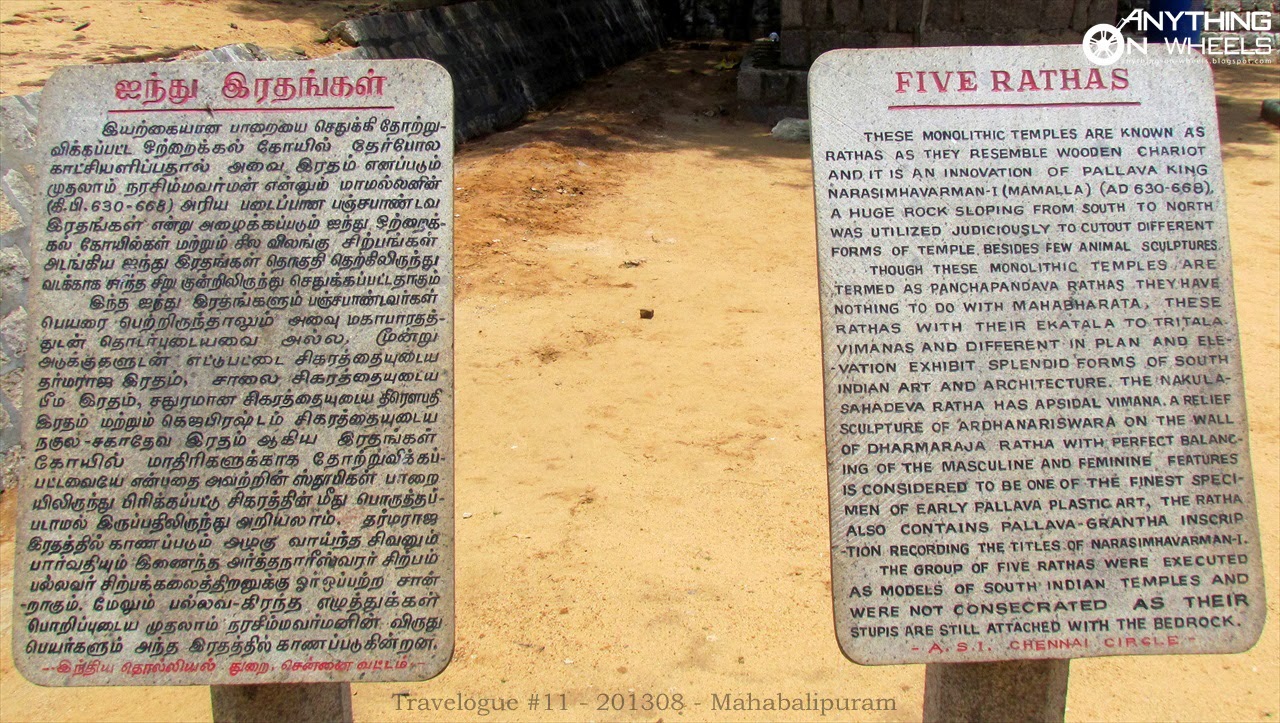
The Pancha Rathas, which means 'five chariots' in English, is yet another must-see destination in Mahabalipuram. Each of the five rathas are made out of a single stone and are named after the Mahabaratha fame Pancha Pandavas and their wife Draupati. It is believed that these rathas are incomplete and have no connection with the epic Mahabaratha, despite carrying those names. Whatever it is, the five rathas are a sight to behold and, quite understandably, is one of the 'most photographed' structures in India. Walk across the road and enter the commercial complex that's lined up with small shops that sell colorful stone-made items and souvenirs.   

Between the Shore Temple and the Pancha Rathas is the Descent of the Ganges or Arjuna's Penance, a huge, glorious, open-air bas-relief that has a crevice at the center intended to depict the descent of the river Ganges to Earth. Another interpretation is that the figure standing on one leg in the structure is that of Arjuna who is performing a tapas to receive a boon from Lord Shiva. A total of 146 carvings including scores of gods, goddesses, mythical figures and animals are immortalized in this structure. The life-size carvings of elephants in this monument are one of Mahabalipuram's post-card images and considered to be amongst the best animal carvings in India.

Just behind the Descent of Ganges is a big complex that has a series of intricately carved caves. Mandapams, as they are called in Tamil, are pillared structures that are cut into rocks, giving the impression of a cave. Varaha Caves, Rayar Gopuram, Ramanuja Mandapam, Ganesha Ratha and a huge stone called 'Krishna's Butterball' that's perched precariously over an open rocky hillock are all interesting and attractive in their own ways. The Light House and Mahishasuramardhini Mandapam inside the same complex are very popular monuments for the awesome views that they offer and get really crowded on weekends.

Unlike many other tourist destinations, Mahabalipuram is at its best when the sun is shining hot. The sunlight brings out the glory of these monuments spectacularly, as is evident from the images posted below. But, there is a flip side to it. The ruthless Chennai weather drowns your energy levels, so much so, you get tired after just a couple of hours. Don't get bogged down though. The beauty and sheer magnificence of these monuments will keep you in a high.

Following in the footsteps of our previous travelogues that took us to Puducherry and Pitchavaram, Mahabalipuram is the third beautiful destination in the East Coast Road. We have made no secret of the fact that we love the ECR and never miss an opportunity to drive along this scenic two-lane highway that runs parallel to the coast. And every time we go there, the road reminds us to stay alert, drive within the limits and get back home with the widest possible grin. This time, it was a toppled Mahindra Scorpio that gave us a grim reminder of what the ECR is capable of doing.

ROUTEMAP:


FACTFILE:

* Total No of Days: 1 (18.08.2013)
* Vehicle Make & Model: Honda Civic

* Odometer Start Reading: 53064 km
* Odometer End Reading: 53196 km
* Total Distance traveled: 132 km
* No of Toll Booths: 2
* Money spent on Toll & Parking: Rs. 118

* Total Quantity of Fuel filled: 12.84 l
* Average Fuel Consumption: 10.28 km/l
* Money spent on Fuel: Rs. 958

* Destinations Covered: Mahabalipuram
* Route Followed: Chennai-Sholinganallur-Mahabalipuram

THE LANDSCAPE:


THE AUTOMOBILE:


Despite visiting this coastal town atleast a couple of times in the recent past, this was the first time we managed to cover its complete grandeur on a single day. Needless to say, it's an experience that is going to stay in our minds forever! Anything On Wheels is here to stay. So, stop staring at this post now and start planning your trip to Mahabalipuram. And if you happen to be in Chennai, all you need is a moisturizer tube and a sun-glass to head out!