Despite its fancy name, we have never been fans of the ‘Badge Engineering’ concept prevalent in the automotive industry. What's the fun in picking a mainstream car, spruce it up with a nip and tuck externally to just about conceal its origins, splash often-excessive amounts of wood, premium leather and chrome inside, kit it up with some additional features and sell it with a 'premium' price tag? Or so we thought! When an opportunity to drive the 2013 Buick Verano, a proper badge-engineered car, in the United States of America beckoned, we jumped at it to find out if it changes our minds.
General Motors hit a rough patch in 2008 when the global recession brought an end to a host of brands in its fold. While Pontiac, Saturn, Hummer and Saab fell victims, Buick was spared the axe thanks to its strong presence in China and USA. The lure of the two biggest markets in the world was too good for GM to ignore.
Since then, Buick has been trying to reinvent itself with a spate of new models armed with style and substance and targeted at the Gen X population. The Verano that shares the Delta-II platform with Chevrolet Cruze and Opel Astra is the newest and smallest of them all.
TO LOOK AT:
Coming from India, a few minutes is all it takes for us to realize that what works in a country like ours doesn’t necessarily work in America. The tastes and preferences here vastly differ from those in the sub-continent or even in Europe. Staid designs are the norm here and the Verano, despite staying close to that definition, adds a touch of class to its arsenal. Being an entry model to a luxury brand, it is essential that Verano attracts buyers and the car doesn't disappoint.


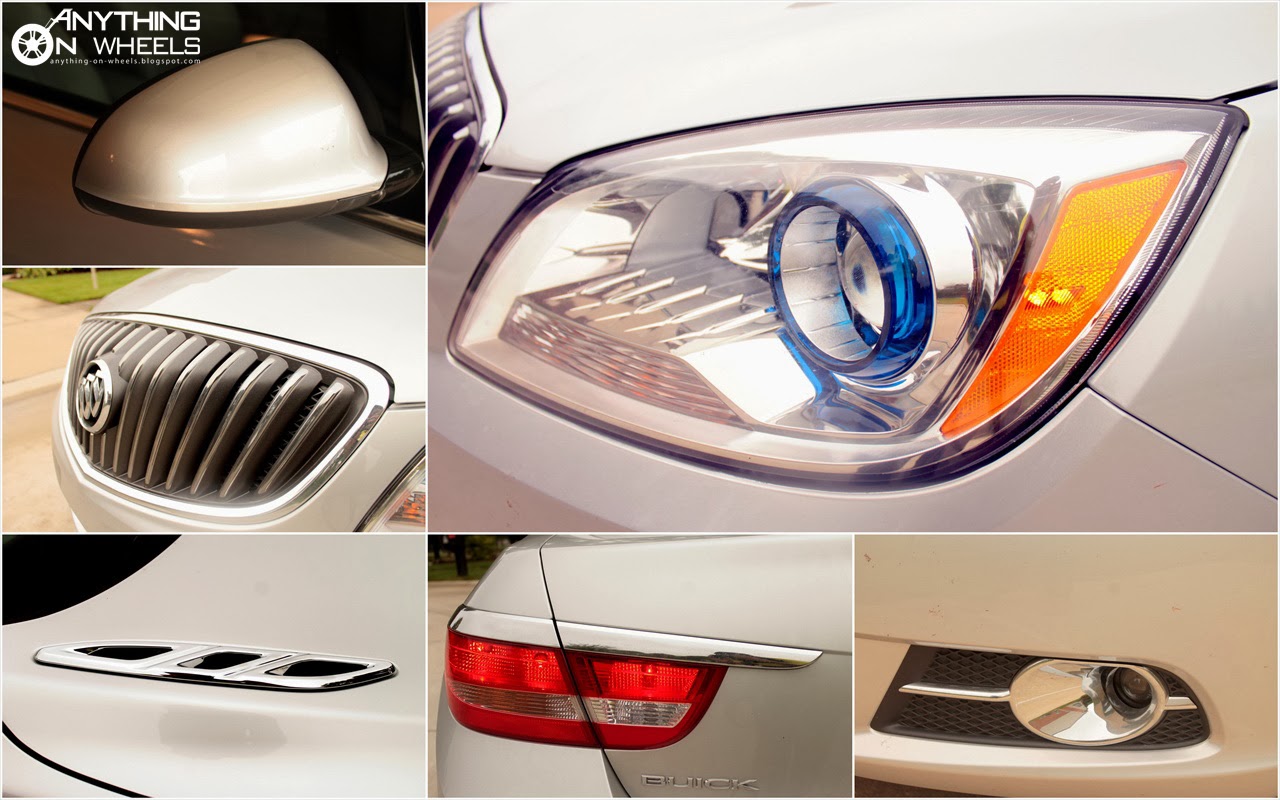
Up front, the trademark waterfall grille with protruding vertical slats finished in chrome and the signature 'ventiports' at the outer edges of the hood screams Buick. Together with the neat trapezoidal headlights and the split air-dams in the bumper, the Verano carries an air of elegance in its frontal design. We are particularly impressed by the blue circular rings in the headlight clusters that adorn all modern Buicks. Flared wheel arches and a pronounced muscular ridge running along the length of the car keep things interesting in profile. The windows that take the shape of the character line are pretty neat too. What’s not pretty, atleast to our eyes, are the huge taillights with chrome strips on top that give an impression of a pair of frowning eyebrows. That apart, we feel that the Verano is impressive enough to attract the younger demographic that GM is targeting with the new Buicks.

The best part is that the Verano gives nary a hint of its origins. Those that aren't closely following the industry would just not be able to identify that the car is actually a Cruze underneath. The Verano wants to move away from its Chevy roots and it does that convincingly. We aren't kidding. How about laminated glasses all around, triple-sealed doors and additional sound-deadening material for reducing the NVH levels? That’s how far this baby Buick goes to differentiate itself from the less premium GM brands.
TO SIT IN:
Step inside and the car again impresses. Except for its size, the Verano is every inch a luxury car, be it in the choice of interior appointments, the list of features on offer or the impeccable fit and finish.
Unlike most of its ‘redesigned and rebadged’ competition that try to hide their origins in vain, the Verano makes you feel special. And that's where it wins. The treatment starts right from the instrument cluster that’s neatly laid out in four elliptical pods. The whole thing, with its ice-blue backlighting and chrome surround for the pods, exudes quality. The LCD panel at the center has nine modes to choose from that, apart from displaying the regular stuff like speed, distance to empty, fuel efficiency and trip info, also offers modes like timer and navigation.

The steering wheel is good to hold and operate with the perfectly-shaped recesses proving to be a great boon for the thumbs that's often left to starve for comfort. All the buttons are of just the right size and shape, irrespective of their location inside the cabin. The combination of colours and materials used all over the interiors ensure that there is no monotony in here. The center console, for instance, has no less than four shades and three types of finish that offer terrific contrast. What makes it nicer is that none of it looks garish to the eyes. Detailing is top notch too, be it the wooden inserts in the grab handles, the nifty parking brake button or the chunky chrome-outlined climate control knobs. Buick's 'Intellilink' infotainment system is fairly simple to get used to.


The premium cashmere leather seats in our test car were plush and offered extremely good comfort levels. The front seats, especially, have good head, leg and shoulder room and offer adequate under-thigh support too. The same can't be said about the rear bench that not only lacks under-thigh support but is also set a bit low for our liking. Space is just about sufficient with the legroom reaching strictly average levels when the front seats are pushed all the way back. This is one area where the Verano can't shake off its roots. Though Buick states that the Verano can seat upto five in full comfort, the high transmission tunnel and the absence of a proper headrest is extremely unwelcoming for the fifth passenger.
With a 5-star safety rating from the National Highway Traffic Safety Administration (NHTSA), the Verano is among the safest cars in its class. In addition to the long list of safety features that include ABS, traction control, stability control and ten airbags, the 'Leather Group' variant that we drove came equipped with premium leather seats, Bose 9-speaker system, push button start, heated front seats, heated steering, rear cross traffic alert, side blind zone alert and a sunroof.
ON THE ROAD:
Buick has given the Verano two engine options, a 2.4-liter, 4-cylinder ECOTEC engine mated to a 6-speed automatic transmission that was available in our test car and a 2.0-liter, 4-cylinder, turbocharged engine that joined the lineup about an year back and is available with the choice of either a 6-speed automatic or a 6-speed manual transmission. The latter powers just the top-of-the-line 'Premium Group' variant.

With the base 2.4-liter engine rated at 180 horsepower at 6700 rpm and 232 Nm of torque at 4900 rpm, the Verano is more powerful than the regular compact cars like the Ford Focus. That would ensure that the buyers, who pay more and expect more obviously, aren't disappointed. The motor offers adequate grunt and makes the Verano a sprightly performer off the line. Slam the throttle and the car moves forward eagerly, but its obvious that the motor isn't enjoying the run as it gets really noisy at higher revs. Save those 'pedal-to-the-floor' runs for another day behind the wheel of the turbocharged variant. The 6-speed auto tranny goes about its job in a smooth and fuss-free way, albeit with a wee bit of lag when the throttle pedal is pressed hard.


Buick's 'QuietTuning' technology has elevated the Verano's ride comfort to an altogether different level. When the doors, windows and sunroof are shut and the music isn't playing, a hushed silence is all you hear inside. The laminated glasses, triple-sealed doors and all those we wrote and didn't write about earlier prove their mettle here. GM's engineers need a pat on their back for going that extra mile in making the Verano what it is. Though American roads are not the right place to judge ride quality, the Verano soaked up occasional bumps and span joints with utmost ease. Handling is predictable and the steering offers respectable amount of feedback. Turn-ins are eager and the Verano won't let you down if you are looking for some fun behind the wheel.

But, if you belong to the group that prefer piloting rear-wheel drive cars, which we know is quite a lot in number in the luxury segment, give the Verano a miss. This car has its limitations stemming from the fact that the platform it shares with other GM cars is front-wheel driven.
In the couple of days that we spent with it, the Verano averaged 25.4 miles per gallon with a driving pattern that fell more on freeways and less on city roads. That's not an impressive score, given that the EPA estimates rate it at 32 mpg highway and 21 mpg city.
SPECIFICATIONS:
| Engine Type: GM ECOTEC In-line |
| No of Cylinders: 4 |
| Displacement: 2.4 L |
| Maximum Power: 180 HP @ 6700 rpm |
| Maximum Torque: 232 Nm @ 4900 rpm |
| Transmission Type: 6-speed AT |
| Tires: 235/45 R18 |
| Brakes: Disc (Front & Rear) |
WE VOTE FOR:
* Premium interiors
* Terrific refinement and ride quality
* Value for money
WE VOTE AGAINST:
* Limited space
* Uninspiring engine
VERDICT:
If you have read through the full post, it would be clear that we are undoubtedly impressed with the Buick Verano. And that also means the opinion that we had about 'Badge Engineering' with our limited exposure till date goes down the drain. Forget the Micra-Pulse and Sunny-Scala episodes that have spoilt us in India, that's not what badge engineering is about. With a conservative yet attractive design, plush interiors, excellent build quality and terrific NVH levels, the Verano shatters our misconception and presents itself as a true-blue luxury car inspite of its humble origins in the Cruze. Yes, the engine isn't that powerful. But there is the Turbo variant for those who are looking for power in their next car. The limited rear seat space might be another issue for which Buick again offers a solution in the form of the bigger and very similar Lacrosse. For all other purposes, the naturally-aspirated Verano is great.

If the Verano is a sign of things to come and Lexus, Acura and Infiniti are watching Buick's moves closely, they better be wary of The General!