20150506

General Motors crosses 500 million units production milestone


Milestones don't get bigger than this. General Motors, currently the world's second-largest car-maker and the largest in the world for much of its 106-year existence, has officially crossed the 500 million unit production milestone. Yes, that's a half-billion vehicles rolled out from GM's plants worldwide. Needless to say, no other automaker ever has achieved this so far and it is going to take long, really long, for others to even come close.


It took until 1964 for General Motors to cross the first 100 million production mark. Interestingly, the subsequent 100 million marks were breached in 1978, 1991 and 2003, much earlier than it took to cross the first hundred. At present, GM operates more than 170 sites spread across 31 countries employing around 190,000 employees.

Speaking on the occasion, GM CEO Mary Barra said, “During 2015, we expect to sell more than 1,000 new vehicles per hour, 24 hours per day. This adds up to nearly 10 million vehicles, the most in our history. I look at this extraordinary volume as 10 million opportunities to prove what kind of company we are and to say thank you.” GM also announced a spate of investments and plant upgradations as part of the celebrations to mark this truly remarkable milestone.


With a strong palette of brands that include Chevrolet, Buick, Cadillac, GMC and Opel, General Motors enjoys an enviable position in China and USA, the two largest markets in the world in terms of volume. Ironically, the General is hardly putting on a show in India, churning out flop after flop and struggling to find favour in our market. With a spate of models apparently getting ready for launch in India, let's hope their current situation in India changes towards the better.

Regardless of that, it is time for us to take our collective hats off for what GM has achieved. Not many car-makers would be privileged enough to cross this mark.

20150504

Renault XBA (Kayou) spotted testing in Chennai ahead of its global debut

Despite its presence in the Indian market since 2010, Renault's only success in India till date has been the Duster. The rest of its models, from the Pulse hatchback to the Koleos SUV, have failed to find favour in the tough and demanding Indian market. Of course, we have discounted the just-launched Lodgy MPV here which might bring in some numbers for the French brand. But, this car could completely rewrite Renault's fortunes in our market. 

Spotted testing in the busy GST Road in Chennai a few hours back by our ardent reader Govind Prasad, this small car codenamed 'XBA' holds Renault's ticket for entry into the big league in India. What else can we say about a car that's set to lock horns with the mighty Maruti-Suzuki Alto and Hyundai Eon? The former has been the largest-selling car in India since 2004 while the latter, despite being a distant second in the segment, still sells more than Renault's entire lineup every month.


Widely reported to be called 'Kayou', this small car would likely be the most-affordable Renault model worldwide and is set to make its global debut in India. Despite its thick camouflage inside and out, Renault's intentions with this car are clear. This is going to be a low-cost model targeted at the value-conscious first-time Indian car buyers. That explains the basic rear view mirrors made of black plastic and the single windshield wiper that is similar to the one that the Datsun Go has. Also visible are the small wheels, possibly 13 inchers held in place by just 3 bolts each, and the relatively larger wheel wells. The car also appears visibly larger than the Alto and Eon and seems to be sitting higher too with broad shoulders and thick C-pillars.


Renault continues to remain tight-lipped on the potential engine and transmission options on its next big launch. The 3-cylinder, 1.2-liter petrol engine that powers its siblings (Pulse, Micra and Go) is a strong contender to power the XBA (Kayou) but Renault is said to be working on a new 0.8-liter petrol engine too which is the norm for this segment. Apart from a 5-speed manual transmission, an Automated Manual Transmission (AMT), the new buzzword in the market, is also said to be on the cards. Renaults have always been fairly robust and hold up well in the harsh Indian market and we expect the XBA (Kayou) to follow that tradition. 

If Renault manages to bring an eye-catching design and an acceptable interior quality, the XBA (Kayou) might hit the jackpot big time. Of course, beating Maruti-Suzuki and Hyundai would be a monumental task. The Datsun Go, that made its global debut in India as a stripped-down low-cost car with much fanfare, bit the dust teaching Nissan and Renault tough lessons in the process. Let's hope Renault learnt from the whole fiasco and succeeds in making the XBA (Kayou) a success. Should the Alto be worried? Nah, nothing can touch it now. Should the Eon then be worried? Hmm, may be yes. Bring it on, Renault!

20150430

Hyundai ix25-based crossover spotted testing near Chennai

​Hyundai hit the bulls eye with the new i20, it’s most-recent model in India that has gone on to become a blockbuster. But, there is one more launch in pipeline that promises to elevate the South Korean manufacturer to the next league. It’s launch would also mark Hyundai’s much-awaited entry into the mass-market crossovers and utility vehicles. At present, the expensive Santa Fe is the only Hyundai SUV on sale with the rest of the portfolio being hatchbacks and sedans. 

Based on the ix25 crossover that went on sale in China last year, the upcoming Hyundai crossover will lock horns with the Renault Duster, Nissan Terrano and, to an extent, Ford Ecosport as well. Crucially, the ix25 measures more than 4 meters in length and wouldn't qualify for excise duty concessions that the Ecosport enjoys. Through the blurred corners of these shots, it is evident that the ix25 compares favorably with the Maruti-Suzuki Ertiga next to it. If reports in other automotive websites are to be believed, the ix25 will get a few India-specific styling elements and a new name when it debuts here later this year.


Spotted testing right outside Hyundai’s facility at Irrungattukottai near Chennai, the test car was covered with thick camouflage. What's interesting is the luggage-carrier fitted onto the roof with a couple of travel bags in tow as well. Is that some kind of load testing going on up there? We aren't sure. Sporting the second iteration of Hyundai’s popular ‘Fluidic Sculpture’ design philosophy, the ix25 looks stylish and sharp. Neither is it as polarizing as the Ecosport nor is it as mundane as the Duster. Typical Hyundai design elements such as a large hexagonal grille with chrome slats, swept-back headlights and an upward-sloping window line would all be present, making this one stylish crossover. 

Amongst others, expect the ix25 to boast class-leading interior quality, fit and finish with tons of features and gizmos. While Hyundai hasn't confirmed anything yet, the ix25 might share its engines and transmissions with the Verna sedan. While the lower 1.4-liter variants might or might not come, the 1.6-liter petrol and diesel engines from the Verna would definitely find their way under the hood of the ix25. Like the Verna, both the petrol and diesel engines might come with the option of a manual or automatic transmission. An All Wheel Drive option, at least in the top-end variant, would make the ix25 a great package.


From what we see in the Chinese version, the ix25 looks like a mini Santa Fe, more so when viewed head on. The Indian version wouldn't look much different, so don't have your fingers crossed. So, are we looking at yet another success story for Hyundai in India? Oh yeah, we think so!

20150429

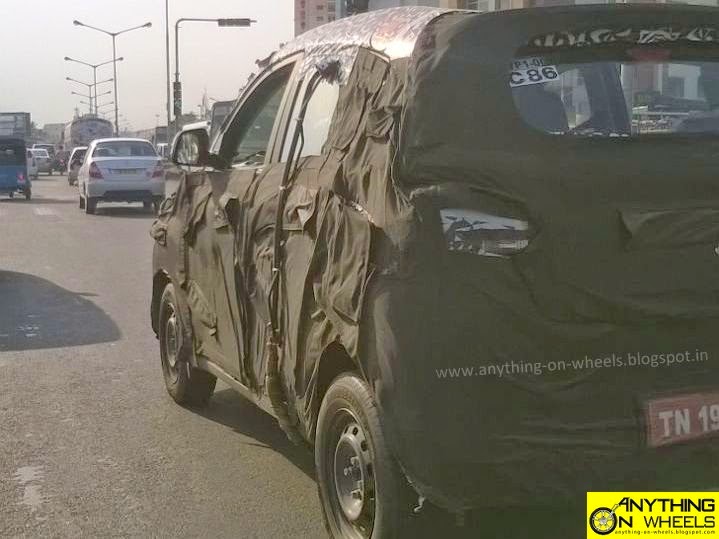
Mahindra's new compact SUV (S101) continues testing in Chennai

Mahindra, the manufacturer of popular Utility Vehicles like the Bolero, Scorpio and XUV 500, appears to be lining up a spate of all-new models in India. In the last few months, we have caught their upcoming new SUV (codenamed U301 and touted to be the Bolero replacement) and their all-new compact SUV (S101) testing in and around Chennai. The testing phase isn't over yet and these fresh shots of S101, that was seen testing in an arterial road in Chennai earlier today, stands testimony to that.


When launched, this all-new model that should be less than 4 meters in length would be Mahindra's first proper shot at success in the compact SUV segment. Currently enjoying a near monopoly in that segment, the Ford Ecosport would have its mirrors full of this new Mahindra SUV soon. 


Though the thick layer of camouflage hardly reveals details, the new Mahindra looks tall and sharp. Picking up clues from the new Scorpio and the upcoming XUV 500 facelift, we expect the new model to feature the new-age Mahindra grille with floating vertical slats adorned with chrome. That apart, the flared wheel arches, the horizontal ridges in the mirrors and the sloping roof and window-line make their presence felt. Let's just hope Mahindra doesn't spoil things with fussy detailing though.


To avail excise duty concessions, Mahindra is set to be working on new petrol and diesel engines with displacements of less than 1.2 and 1.5 liters respectively. As usual, the mechanicals and underpinnings should be robust and last the distance, two typical Mahindra traits.

With the Bolero, Scorpio and XUV 500 pulling in tens of thousands of customers into Mahindra showrooms every month, the upcoming compact SUV is only going to strengthen the Indian manufacturer's position in the market.

20150414

Zest isn't selling well, but is Tata Motors to blame?


So, it's official now. More than six months after launch, the Zest isn't doing great business out there. At least, it isn't selling as well as we thought it would. Who is to blame here? Tata Motors of course, you might say. Really? Read on.

Circa 2008, on a cold morning in New Delhi, the hugely-anticipated '1 Lakh Car', the Nano, made its debut. Instead of focusing on its finer aspects and how the Nano was actually better than what everybody envisaged it would be, the media went gaga over its price, labeling it the "world's cheapest car." Poor little thing, that very same tag and vested political interests put paid to it's prospects even before the car rolled out of the factory gates. "They killed the Nano with the cheapest car tag and a botched marketing strategy," declared the media, placing the blame squarely on Tata Motors. Of course, a few instances of Nanos catching fire didn't help either.

Came 2010 and the Aria, Tata Motor's most ambitious and most expensive model then, debuted. Pitted against the mighty Innova, the Aria had the road presence, a gamut of creature comforts and safety features, a well-sorted chassis and, most importantly, was priced lesser than the bare-bones Toyota. But, the public weren't ready to see the value proposition there. Instead, they chose to look at the 'more than a million rupee' price tag and shunned the Aria. It struggled to even sustain double digit sales figures every month and Tata's attempt to boost sales by price cuts weren't successful too. Tata Motors was blamed again, this time for the Aria's perceived premium positioning.

The Safari Storme came and hardly made an impact at a time when the Boleros, Scorpios, XUVs and Dusters were ruling the market. The Bolt, the newest Tata in the market launched just two months back, is already struggling. And with each flop show that Tata Motors adds to it's kitty, the criticism and blame game continues too!


And that brings us to the Zest. Here is a car that's not just a match for the competition but, in many aspects, better than the rest too. Be it in styling, interiors, features and ride quality, the Zest has the Dzire, Amaze and Xcent covered. It even offers a turbocharged petrol engine with three driving modes to choose from and has a frugal diesel engine mated to an Automated Manual Transmission, both of which are segment-firsts. Heck, even the build quality of Zest can stand up to the best in segment and that's not something we would normally say about a Tata. To top it all, it is incredibly well-priced too. With all these in its favor, the Zest should sell exceedingly well, right? Alas, that's not the case. The Zest languishes at the bottom while Maruti-Suzuki, Honda and Hyundai laugh all the way to the bank.

We can't help but feel for Tata. When they were blamed for the Nano, Aria, Storme and Bolt debacles, we kept mum. That's because Tata could have done certain things better in each of those cases. But the Zest is a genuinely impressive attempt, one that deserves to be rewarded with success. If the Zest can't make the market realize the strides Tata has made, what else would? For once, we are sure to state that Tata is not to blame. It's the market perception at fault here.

As for Tata, they should keep doing what they did with the Zest in all the new products that are in the pipeline and hope the market perception changes. Honestly, that's all they can do. The rest is with us. Let's give them a chance, shall we? They have, after all, come a long way since the Indica in 1998.