20110212

Is 'Blue' the new 'Green'?

It’s a known fact that fossil fuels, from which gasoline and diesel that powers almost all the automobiles on earth are made, are not going to be available for eternity. From hugely successful and mass-produced gas-electric hybrids to relatively lesser successful full electrics to the still-under development fuel cell and hydrogen vehicles, automobile companies are draining the brains of their experts to find an alternative to replace the traditional Internal Combustion Engines.

While its going to take at-least a decade or two for this seemingly never-ending quest to come to an end, car companies cant afford to sit still until then. They have chosen to make the existing IC Engines cleaner and more fuel efficient. When so much efforts are being put, would any company want them to go unnoticed? The answer is an obvious no and here starts the problem of branding them, typically with a catchy surname pointing out their 'doing good to nature' quality.

Universally, everything that is 'environment friendly' are coined with an adjective ‘green’, which is quite understandable as green has always been tied to nature. But what is most surprising is how a host of manufacturers have chosen to ignore this and call the greener variants of their models ‘blue’. While Mercedes-Benz has chosen ‘Blue Efficiency’ to denote their models specifically tuned for better fuel efficiency and lesser emissions, Volkswagen prefers to call them ‘Bluemotion’ and Hyundai has come up with a ‘Blue Drive’ moniker for the same.

Is there any out-of-the-world relationship between blue and green or is 'blue' really the new 'green'? I don't quite understand.

20110211

Hyundai 800cc Small Car (HA) spied testing in NH4

The Chennai-Bangalore highway (NH4) is turning out to be a hot spot of activity for automobile companies for testing their yet-to-be-launched models. Most recently, the highly publicized and much awaited 800cc car of Hyundai, being referred to as 'HA' was caught testing in the highway near the company's factory. When I spotted this camouflaged car, it was immediately apparent that it was a Hyundai, the 'headlights' making sure that I didn't mistake this for any other model.

At first sight, its clear that this new model will continue Hyundai's international styling trend that we all are now familiar with in the i10. The fluidic headlights with clear partition for indicators, the hexagonal grille (as outlined by the camouflage), the upward sloping rear windows and the tipped-forward aggressive stance - all are clearly visible. Overall, we can safely expect the car to bear a strong family resemblance to other Hyundai cars, especially the i10 and that's no bad thing at all.

The car also seem to be noticeably smaller than the other two tall boys from Hyundai - the Santro & i10. But, when its main competitor is going to be the Alto, it only makes sense for Hyundai to come out with a similar sized car. Its a known fact that Hyundai is developing a new 800cc 3-cylinder engine in the 'Epsilon' platform to power this car. The Epsilon engine, in its current 4-cylinder form, has been doing duty in the Santro since 1998 and more recently in the base versions of the i10 as well.

Though Hyundai is still tight lipped about the car's launch date, its being widely speculated that it will hit the roads in the third quarter of 2011. If priced competitively at around 2.5 to 3 Lacs, we can surely expect the car to take the fight to India's numero uno best-seller, the Alto, which has been enjoying a monopoly in that segment. Personally, I can't wait long to see this happen.

20110202

Daimler celebrates 125th Anniversary of the Automobile & MB post-war deliveries touch 30 Million

“You learn something every day if you pay attention”, goes a saying. Whats so surprising is the way in which ‘life’ reminds us of this fact with amazing regularity, the most recent one for me being this news which I came to know just a couple of days back. I may boast of possessing considerable knowledge in automobiles that had made me go to the extent of blogging about it. I may have also remembered faintly the fact that Carl Benz was the inventor of motor car. But, never did I get to know all these days that, as an honor of Carl Benz’s invention, the day in which he received the patent is being observed as ‘World Automobile Day’. It was on 29th of January, 1886 that Carl Benz was awarded the patent 37435 for his ‘vehicle with gas-engine drive’.

Now, 125 years after that historic day which had changed the meaning of ‘personal mobility’, Mercedes-Benz and the parent brand Daimler are celebrating the ‘Anniversary of the Automobile’ with a slew of events. It is, quite obviously, a matter of great pride for everyone associated with Daimler. Dr. Dieter Zetsche, Chairman of the Board of Management of Daimler AG and Head of Mercedes-Benz Cars, emphasized the importance of the automobile on speaking on the occasion. "The invention of Daimler and Benz has changed the world for the better and it will continue to do so. History shows that when a society becomes physically mobile it also becomes socially mobile and economically successful."

The company kicked off the celebrations in the best way possible by receiving yet another patent, this time for ‘bipolar flat-cell frame’, a battery-related technology still under development at Daimler. As if to emphasize the importance of fuel cell electric vehicles, Mercedes-Benz also started a World Tour of three B-Class Fuel Cell cars which would travel across the globe in 125 days. Also unveiled during the celebrations was the latest sculpture from Mercedes-Benz Design Team, the ‘Aesthetics 125’. The sculpture not only continues the philosophy that ‘Mercedes-Benz design is art’ but also provides a glimpse of the future design language of the brand.

Also, right on time for the 125th anniversary celebrations, Mercedes-Benz also reached yet another historic milestone. Since 1945, after 65 years of post-war production, Mercedes-Benz cars with the iconic ‘three pointed star’ have been delivered to 30 million customers across the globe. Way to go MB! Now, before the reality sets in, let me start dreaming of owning a Mercedes-Benz just in time to atleast join the 150th anniversary of the automobile.

20110125

Volvo successfully completes first real world testing of SARTRE Concept

Across the world, the name 'Volvo' is synonymous with safety & innovation. So, it shouldn't come as a big surprise that Volvo has partnered for yet another innovative program called SARTRE. In case you are wondering, SARTRE stands for 'Safe Road Trains for the Environment'. It is led by Ricardo UK Ltd and comprises a collaboration between the following companies - Idiada and Robotiker-Tecnalia of Spain, Institut for Kraftfahrwesen Aachen (IKA) of Germany, SP Technical Research Institute of Sweden, Volvo Car Corporation and Volvo Technology of Sweden.

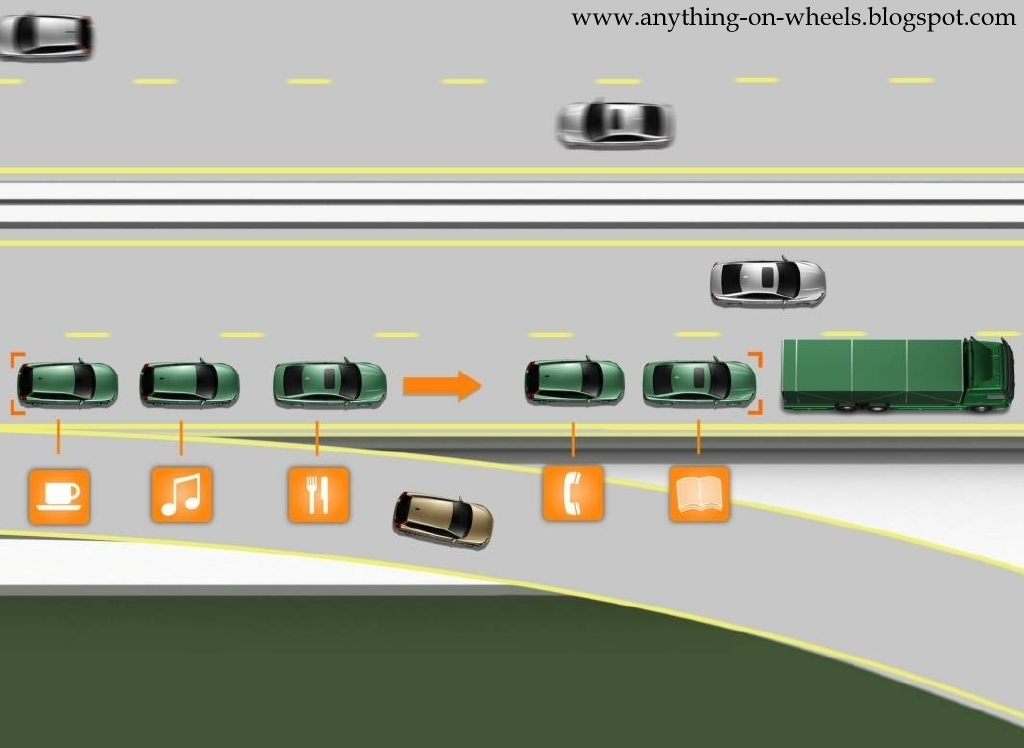
The project aims to encourage a step change in personal transport usage by developing environmental road-trains called 'platoons'. Systems will be developed facilitating the safe adoption of road-trains on un-modified public highways with interaction with other traffic. A scheme will be developed whereby a lead vehicle with a professional driver will take responsibility for a platoon. Following vehicles will enter a semi-autonomous control mode that allows the driver of the following vehicle to do other things that would normally be prohibited for reasons of safety.

To put it simply, a platoon works like this - A 'Lead Vehicle' will be driven by a professional driver between two destinations. Other road-users would be free to join the lead vehicle as and when they need, thus forming a road-train. Once in the train,  the vehicles will follow the actions of the lead vehicle through a complex system of sensors and telematics. When a particular user reaches his/her destination, he/she can voluntarily disconnect from the train and drive independently.

If you are thinking that the concept is all fine and how is this going to work out in real life, worry no more as Volvo and its partners have just completed the first successful on-road testing of this concept at Hallered test track in Europe. The Volvo truck (in the picture) acted as the Lead Vehicle with a professional driver behind its wheel. The Volvo S60 sedan joined the truck to form a platoon. As the electronics took over the control of the S60, the car was autonomously following the actions of the truck ahead of it and the car’s driver was free to take his hands off the wheel and do things as he wished. In the picture, you can see him sipping a cup of coffee and glancing through a newspaper.

As per SARTRE members, this technology, when implemented, will set free time for the driver, improve safety and decrease the environmental load. Of course, this test is just the beginning and it’s going to be many years before the system is refined, perfected and can be termed fit for road usage. But, for the project members, that’s going to be a much easier job than convincing the transport authorities and common people to take up this technology without any fear or apprehension. If that happens, then this would be yet another classic example of the machines getting smarter than humans.
 
(Pics Courtesy: Volvo Cars)

20110120

Spotted #3: Ford GPW (World War II Jeep)

A year and a half is quite a long time by any standards. That's precisely how long back I spotted an interesting automobile on road, something exotic or vintage, which spurred me to chase, snap and post it in my blog.

Today, when I first saw this jeep overtaking our Indica which was cruising at about 70 km/hr along the GQ near Tambaram in Chennai, I dismissed it mistaking it for an old Mahindra Jeep. Only then it dawned on me that its actually a vintage World War II Jeep which should have been made either by Willys or Ford. The jeep had actually went so far by then, it took a couple of minutes for us to get close to it again.

Immediately noticeable was the huge 'Ford' logo embossed in the rear, thus clearing the confusion and giving an hint that it should have been originally manufactured around 1941~42. Apart from the embossed Ford badge, the nine-slotted grille, the indicators and the split front windshield were some of the few noticeable authentic parts left in that vehicle. Most of the other iconic WW II Jeep accesories like the pickaxe and shovel in the left side, jerry can in the rear and one of the side lamps in the wheel arch were not to be found. The fact that it was converted to RHD and the presence of fake parts like the Mahindra taillights spoiled its originality.

However, what surprised me most was the fact that it was moderately well-maintained and comfortably did speeds of about 75 km/hr in the NH. What surprised me least though was, even after so many decades, it still managed to turn heads all along the way. I only wish that it had all the original bits of the Ford GPW so that I could have feasted my eyes even more.