20121124

Mahindra Alfa auto-rickshaw spotted testing; Is this the CNG variant?

The arrival of Tata Ace and its associated variants reduced the once-flourishing three-wheeler market into an also-ran, with volumes getting so meager that we thought manufacturers would be looking to exit the segment for greener pastures. Mahindra, which has a product called Alfa competing in that segment with both Goods and Passenger variants, was also expected to pull out of that segment gradually. With the success of four-wheelers Maxximo and Gio, the end of Alfa was imminent. Or so we thought.


But, Mahindra has other plans. They are not only going to continue selling the Alfa in the existing Goods and Passenger forms, but are also trying to expand the range and grow it further it seems. This Alfa auto-rickshaw was caught testing in an arterial road in Chennai yesterday. Though it could have easily passed off as just another auto-rickshaw with looks that are remarkably similar to the Piaggio Ape, the current market leader in three-wheelers and the prime competitor of Alfa, the test registration plates and the ‘On Test’ sticker clinched that there is something new brewing up in there.


Though we couldn't figure out what is new in this Alfa compared to the model that is currently on sale, we could speculate where Mahindra is heading to with this. While the Alfa goods carrier is available in both diesel and CNG variants, the Alfa people-mover is only available with a diesel engine that produces all of 8 hp of power. With auto-rickshaws in most Indian cities opting for CNG these days for the dual benefits of lower running costs and lesser emissions, it is imperative that Mahindra Alfa comes with a CNG variant as well to tap the market.


Is that what Mahindra is working on? It could be, despite the absence of CNG stickers and the customary green paint job synonymous with CNG vehicles, in this test vehicle. More details, if any, about this Alfa are welcome.

20121122

Michael Schumacher sets yet another record, has driven around the world twice in a Formula 1 car


We Formula 1 fans are bracing ourselves and doing all that we could to keep our interest in the sport intact after Michael Schumacher heads into his second and, in all probability, final retirement. Come this Sunday's Brazilian Grand Prix, Michael Schumacher won't be seen piloting a Formula 1 car again in a race. He may have decided to leave the sport for good but the records that he set during his racing tenure are here to stay. The most recent one came when Michael Schumacher completed Lap 10 of the American Grand Prix at 'Circuit of the Americas' last weekend.

With that lap, Schumi has covered a staggering 80,000 kilometers (or 49,710 miles) racing in a Formula 1 car. Including the distance that he will be covering at the season-ending Brazilian Grand Prix at Interlagos this weekend, Schumacher would have covered a distance equivalent to twice the circumference of Earth racing in a Formula 1 car. We just can't imagine the amount of G-Forces that his body and mind would have gone through to stay at the top of this physically and mentally demanding sport for such a long time. That probably explains why he is loved, respected and revered so much across the world.

This feat was achieved over a career that started in 1991 and has lasted for 19 long years with a gap of 3 years in between (2006 - 2009) when Schumacher went into his first retirement before coming back to the lure of racing in Formula 1 with Mercedes GP. In this period, Schumacher has amassed 7 World Championships, 68 Pole Positions, 91 Race Victories and 1560 Points racing for teams such as Jordan, Benetton, Ferrari and Mercedes. Those are statistics that are set to remain in the sport for a long time before any racer even gets a chance to better them.

Source: www.autoblog.com

20121115

Sales of Tata Ace mini-truck crosses 1 Million units

It’s amazing how Tata Motors, with all the brickbats that it receives on a regular basis, continues to be a trend-setter in the automotive space, often creating whole new segments in the process. We need not remind you about the flutter that Tata created across the globe when the Nano, unfortunately popularized as the ‘world’s cheapest car’, was first unveiled at the 2008 Auto Expo. At the same time, not many would be remembering the Nano’s predecessor of sorts, a model that followed the same concept as Nano, in commercial vehicles. Yes, we are referring to the Ace mini-truck, a success story beyond description.


The Ace was conceived and developed to fill a void in the market for last-mile goods carriers, where Tata Motors thought was great potential. That was a segment dominated by rickety and noisy three-wheelers like Piaggio Ape, Force Minidor and Mahindra Champion Alfa. Boy, were they right? The arrival of Ace not only created an all-new segment in the commercial vehicle space but also spelled doom for the three-wheeled goods carriers. The advantages of Ace in terms of comfort, stability and power vis-à-vis the competing three-wheelers were glaringly obvious and too good to ignore for the customers. As a result, the Ace went from strength to strength and forced every other manufacturer out there to come out with a model to compete against it. Mahindra Maxximo, Force Trump, Piaggio Ape Truk, Ashok-Leyland Dost, etc. should thank Tata Motors for their very existence.


First launched in 2005, the Ace was an instant hit and sales during the initial period was restricted only due to limited production capacity. Once the Pantnagar plant in Uttarakhand came on steam with a capacity of 500,000 units per year, sales shot up significantly. As is the norm with Tata, they just kept adding variants to the Ace line-up, the most significant being the Ace Magic people-carrier which has stormed the semi-urban and rural marketplace. To give you an idea, Tata now sells Ace HT, Super Ace and Ace Zip in goods segment and Ace Magic, Magic Iris and Venture in the passenger segment, all of which are based on the same platform. It doesn’t end there. Tata Motors is planning to launch a facelift of the mini-truck called the Ace EX along with many new variants to keep the Ace line-up as fresh as a daisy.


With cumulative sales of the Ace mini-truck crossing 1 Million units, Tata Motors recently held a press release to celebrate the occasion. The landmark was achieved in August-2012, just 2680 days from the date of its launch. While it took 2 years to cross the first 100,000 units, sales crossed 500,000 units in 2010, just 5 years after launch. The remaining 500,000 units, remarkably, were crossed in just 2 years. To put this achievement in the right perspective, the Ace has crossed 1 million unit sales quicker than some super-successful passenger cars in India like the Maruti-Suzuki Alto and Hyundai Santro.


Without a doubt, the Ace family has become a phenomenon in India like no other. The best part is that this success is all set to continue. If only Tata could replicate this in the passenger car segment with the Nano, we would be glad!

20121108

Another variant of Tata Indica spotted testing in Pune; Is this the Indica XL?


It seems Tata Motors' fetish with the Indica platform isn't over yet. Or that's what these shots captured in Pune late last evening convey us. Sent in by one of our regular contributors who confirmed us that the front half of this vehicle is exactly similar to the new Indica eV2, we now know that Tata is working on yet another variant of the Indica family. Though the rear end is camouflaged to look like a Station Wagon or a Multi Purpose Vehicle (MPV), the complete absence of rear overhang makes us speculate that this could be a hatchback, albeit an extended one with a really long wheelbase.


Though many other automotive websites have already concluded that this is the XL variant of the Indica hatchback, we would like to wait until Tata Motors opens up on this subject. For the moment though, we leave it to you to decide whether this is a hatchback with an extended wheelbase, a small car-based MPV or a mini Station Wagon. After all, they could spring up a big surprise, just like they did with models like the Indigo CS and Ace range of commercial vehicles, both of which were religiously copied by many other manufacturers.


Whatever it is, Tata Motors seems to be not content with the number of variants and body styles that it manufactures and sells on the tried and trusted 'Indica' platform. Once launched, this new model will be joining a long list of models such as Indica, Indigo, Indigo Marina, Indica eV2, Indigo CS, Indigo eCS, Indigo XL, Indica Vista and Indigo Manza, all of which share their underpinnings with the first Indica that was launched a decade and half back. It looks as if Tata Motors isn't going to stop until every available gap in the passenger car spectrum below INR 10 Lakhs is plugged.

Though Tata's effort in eking out every last drop of money out of the age-old Indica platform must be commended, its high time they start developing an all-new platform that is totally different, both in terms of design and engineering, from what we have seen and experienced with Tata till date. Are you listening Tata?

20121103

Chevrolet launches Sail U-VA, the first of a raft of new models, in India


After conquering China, the world's largest car market where it is one of the best-selling cars, and teasing India with hundreds of spy-shots captured across all major cities, the Chevrolet Sail U-VA was finally launched in India yesterday. Replacing the market dud Aveo U-VA, the Sail U-VA has got to be one of the most important launches for General Motors in India. With the premium hatchback segment growing like there is no tomorrow and cars like Maruti-Suzuki Swift and Hyundai i20 breaking all sales records each month, it is essential that GM has a worthy model to compete and take sales away from competition.

The Sail U-VA is the car GM has chosen to entrust with that job. The car is available in 4 petrol variants - Base, LS, LS ABS & LT, that are priced at INR 4.44, 4.83, 5.18 and 5.57 Lakhs respectively. 3 diesel variants - LS, LS ABS & LT are also available with prices of INR 5.87, 6.19 and 6.62 Lakhs respectively. All prices are ex-showroom Delhi.

To avail excise duty benefits, the Sail U-VA is powered by a 1.2-liter petrol engine and a 1.3-liter turbo diesel engine developed jointly with Fiat. While the former produces 85 bhp of power at 6000 rpm and 11.52 kgm of torque at 4400 rpm, the latter churns out 77 bhp of power at 4000 rpm and 20.90 kgm of torque at 1750 rpm. This very-popular diesel engine that has earned a name for itself under the hood of many cars like the Swift, Swift Dzire and Indica Vista, is expected to be a major draw for the Sail U-VA. Though the power and torque figures aren't breaking new grounds, they are par for the segment.


Unlike previous Chevrolet models like Beat and Cruze that came with strikingly modern design that vowed the onlookers, the Sail U-VA looks plain jane. That doesn't mean it looks bad, it's just that the Sail U-VA looks so conservative with a 'please-all-offend-none' design. The characteristic split grille with the 'bowtie' emblem in the center ensures that you don't mistake the car for anything but a Chevy. The profile is boxy while the rear with its vertical taillights does look a bit dated, especially when compared to cars like Fiat Grande Punto, Volkswagen Polo and Hyundai i20.


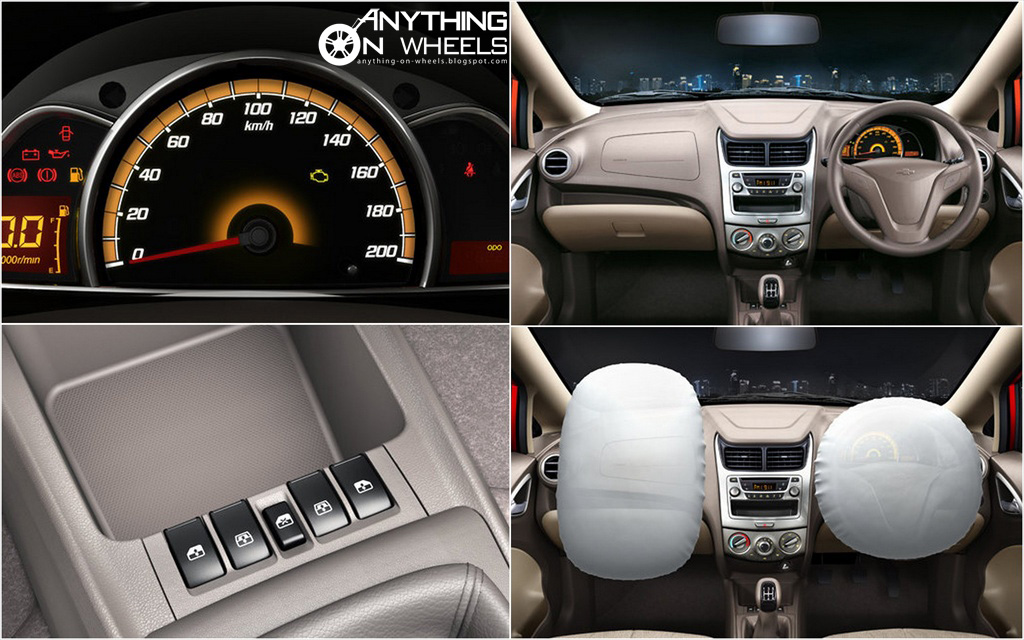
In terms of interior features, the Sail U-VA, again, doesn't break existing barriers. While all variants come with power steering, front power windows, power mirrors, tilt steering and a digital tachometer, features like leather-wrapped steering wheel, ABS, dual Airbags, leather-wrapped gear knob, rear power windows, alloy wheels, audio system with bluetooth, speed-sensitive auto locking and rear wipers get added progressively as you move up the range. Having ran into folks who have thoroughly experienced the Sail in China, we can vouch for its class-leading passenger space in both the front and rear seats.

The Sail twins have been developed by GM India jointly with its Chinese partner SAIC which, until recently, was holding a major stake in the Indian arm. Quite a few India-specific changes like increased ground clearance, addition of beige trim, added interior features and upgrades to the air-conditioning system, suspension and component quality are said to be incorporated to ensure that the Sail withstands the harsh Indian environment better. Over the course of time, the Sail sedan will also join the line-up to take on entry mid-size sedans like Maruti-Suzuki Swift Dzire, Tata Indigo CS and Mahindra Verito.