20170310

2017 Geneva - Arteon debuts as Volkswagen's new flagship

Volkswagen hogged the limelight at the 2015 Geneva Motor Show with the stylish Sport Coupe Concept GTE, thereby previewing the design direction of the brand as well as a potential future model. Two years hence, at the same venue, Volkswagen is doing a repeat act, this time with the production version, christened the Arteon.

When it goes on sale this autumn, the Arteon will slot in above the Passat as Volkswagen's new flagship.


Little has changed in the two years it took Volkswagen to convert the concept to a production model, meaning the Arteon looks as good as, if not more, than the Sport Coupe Concept GTE. Wide, low-slung, sleek and devoid of overdone cuts and creases in the sheet metal, the Arteon impresses with clean lines and spot-on proportions. The front end is characterized by the long hood that extends deep into the fenders on either sides like sports cars and the wide radiator grille that runs end to end. The large single-piece grille feature two distinct sections, the upper half merging seamlessly with the headlights and the lower half defining the lines in the bumper. Other attractive elements include the flared wheel arches, the coupe-like roofline, the horizontal character line running the length of the car and the prominent bootlid spoiler.


The Arteon, Volkswagen claims, is a gran turismo. That meant the focus during development was as much on space and practicality as was on design and styling. Helping the cause is the Modular Transverse Matrix (MQB) platform on which the Arteon is based. In this layout, the engine is transversely mounted, thereby liberating space. Volkswagen claims impressive rear legroom and luggage space that could be extended up to 1,557 liters.

The interiors are a typical Volkswagen affair with build quality and function taking precedence over form. Of course, the flat-bottom steering wheel and the slim air-conditioning vents that span the length of the dashboard look great and add a touch of class to a cabin that looks plush, well-built and neatly laid out. The center console houses a 9.2-inch infotainment screen that feature intuitive gesture control and makes do without analogue buttons.


As you would expect from a flagship, a host of advanced driver assistance and convenience systems make their debut in the Arteon. These include Adaptive Cruise Control that takes into account the speed limits and route information, dynamic cornering lights with predictive beam control, advanced second-generation Emergency Assist that’s capable of steering the car automatically into the slow lane while simultaneously braking the car to a stop, Lane Assist that reacts to other vehicles, Proactive occupant protection system (PreCrash), Side Assist and Sign Assist. 

In terms of powertrain options, the Arteon gets a choice of two petrol engines (1.5 TSI and 2.0 TSI) offering three states of tune from 148 horsepower to 276 horsepower and the 2.0 TDI diesel engine with three different states of tune from 148 horsepower to 237 horsepower. Transmission options include a 6-speed manual and the popular 7-speed DSG dual-clutch automatic transmission. 

As impressive as the Arteon is, India is not likely to feature in the list of countries where the car would go on sale. But wait, did we tell you the Passat is headed here?

20170309

2017 Geneva - Ferrari rocks the show with the 812 Superfast

In the world of automobiles, Geneva is where the Italians generally go and have fun. It’s been no different this year. Running circles around all the other debuts at the 2017 edition of the Geneva Motor Show was Ferrari with the unveiling of the 812 Superfast. 

Ferrari’s newest supercar is also probably the last of the brand’s legendary naturally-aspirated front-engined V12 speed machines with the next generation cars likely to go the hybrid route. But, the 812 Superfast ends the tradition on a high. How, you ask? The 812 Superfast is the fastest and the most powerful road-going regular Ferrari ever built.


Housing a 6.5-liter V12 engine under the hood, the newest supercar from Maranello generates a whopping 788 horsepower and a massive 718 Nm of torque. Those are incredible figures for an engine that’s not force fed. With no turbo lag to tackle and as much as 80% of the peak torque available at just 3,500 rpm, this Ferrari would be nothing but sheer driving nirvana. 


The Ferrari 812 Superfast is super fast with the 0 to 100 km/h sprint taking just 2.9 seconds. The 200 km/h dash is dispatched in 7.9 seconds while the claimed top speed is 340 km/h.


Every new Ferrari is a sight to behold but the 812 Superfast has got to be the most striking new car from Maranello in years. The silhouette, especially, is gorgeous with the rising fastback shape and the long flowing hood creating a lasting impression the moment our eyes come into contact. The graceful quad circular taillights we’ve seen and loved in many Ferraris of the past returns in the 812 Superfast. 


From the pictures, the interiors appear to be sporty yet plush enough to let the owners immerse themselves in the experience. Though driving a V12-engined Ferrari and not hearing to its glorious scream sounds like sacrilege, there are some who do that, it seems. That explains why Ferrari offers a high-end audio system with 12 speakers and a 1,280 Watt amplifier with Quantum Logic in the 812 Superfast.

If you have been reading this post so far, you obviously aren’t one of those fortunate few who would get to own this legend-in-the-making. Well, atleast you now know what’s your desktop wallpaper would be for the next few months.

20170308

2017 Geneva - Tata shines with the TAMO RaceMo

Tata Motors have been doing a lot of things right recently. The Tiago and Hexa have impressed the critics and the customers while the upcoming Tigor and Nexon have struck all the right chords so far. While we do not know if this can be considered in the same breath yet, there is no denying the fact they are trying something different. In case you are wondering, we are referring to the new sub-brand introduced by Tata Motors - TAMO.

In short for ‘T’ata ‘A’dvanced ‘MO’bility, TAMO is part of Tata’s “FutuReady” approach which will see the automaker partner with global startups and tech companies on future technologies, mobility systems, connected car programs and the likes. In short, TAMO is expected to bring Tata up to date with the prevailing global trends. As it works on a low volume, low investment model, TAMO would also help Tata present advanced concepts and off-beat offerings that wouldn’t have made a positive business case otherwise.


A series of well-timed teasers and a countdown running up to the 2017 Geneva Motor Show meant TAMO kept buzzing in the social media the past few weeks. With all that hype, the pressure was on Tata to ensure TAMO didn’t turn out to be a damp squib at Geneva. Boy, did they deliver!


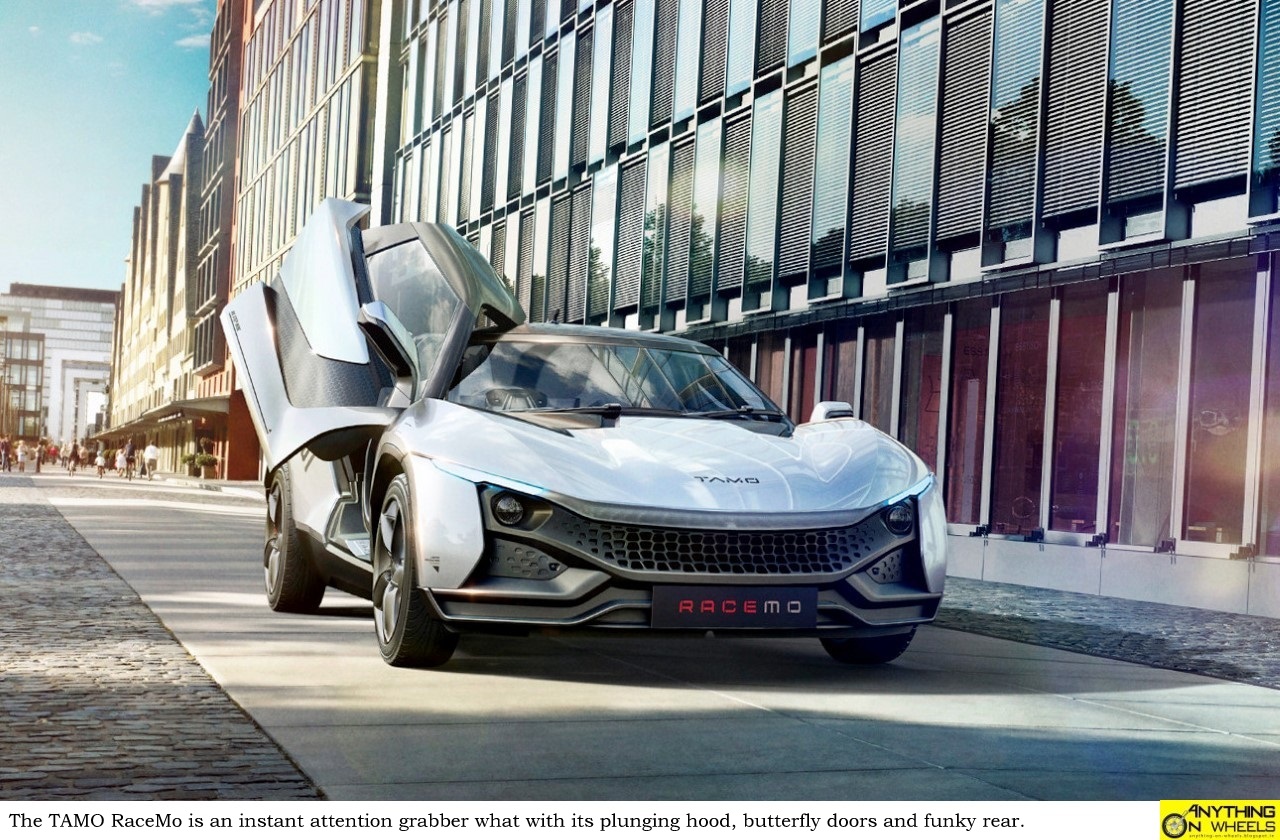
Meet the TAMO RaceMo, India's first proper sports coupe. Yes, that's a two-seater mid-engined sports car from the brand that makes the Indica.


Powered by a tiny 1.2-liter 3-cylinder Revotron petrol engine, the RaceMo develops 187 horsepower at 6500 rpm and 210 Nm of torque at 2500 rpm. A 6-speed Automated Manual Transmission (AMT) with paddle shifters and push button reverse takes care of transmitting the power to the rear wheels. If the engine displacement and specifications aren’t impressive enough, the claimed 0-100 km/h acceleration time of under six seconds sure is.

The performance is backed up by styling elements that are sure to stand out in a crowd. The plunging hood, the butterfly doors, the unique bubble-shaped structures in the roof, the contrasting engine cover with air intakes, the floating rear wheel arches and fender panels and the high-mounted center exhaust make it an arguably busy design. So be it, we say. Tata needs every bit of attention the RaceMo might attract when seen on road and some more. Inset Bi-LED headlamps, thin LED DRL strips and circular LED taillights complete the look.


The interiors are flashy and futuristic with switches, a part of the center console and the fabric door pulls finished in a bright red colour. The flat-bottom steering wheel with a host of buttons and the three LCD screens that make up the instrument cluster look interesting and, of course, funky. This is where TAMO’s recent partnership with Microsoft will likely help, what with the various connected car tech the two firms would work together on. Don’t miss the ‘Take Selfie - Picture’ and ‘Record Selfie - Video’ options displayed in one of the screens.


Equipped with independent double wishbones all around, the RaceMo has a staggered wheel setup with 205/50 17-inchers up front and 235/45 18-inchers at the rear. In terms of safety, the car gets a driver airbag, passenger airbag, disc brakes on all four wheels and ABS with EBD. Ground clearance is an impressive 165 mm, more than what we get in some mainstream family sedans out there.

The RaceMo is built on a patented MOFlex Multi-Material Sandwich structure that, Tata claims, is being used for the first time ever in the automotive industry for passenger vehicles. With a modular design approach that enables large scale part integration, the RaceMo has lesser number of parts, lesser complexity and has a faster development cycle compared to a regular car.

That’s not all, there will also be a track-only version, the RaceMo+, with more vents, an adjustable front splitter, a massive rear wing and bright red accents. Inside, the RaceMo+ is equipped with racing seats, a different steering wheel without the airbag and a stripped out cabin.


250 units of these would be produced, with the first of them expected to go on sale as early as end 2017. With a rumored price tag of around 25 Lakh Rupees, we think TAMO should have no problems in selling the 250 copies of this image-booster of a product. 

For the rest of us, the RaceMo is available for download in the popular Forza Horizon 3 game from Microsoft.

20170304

Range Rover unveils the stylish new Velar

Range Rover may have redefined luxury off-roading since 1969 but not until 2005 did it embark on a model range expansion. The Range Rover Sport in 2005 and the sexy Evoque in 2010 were welcome additions to the range. With each of these becoming a success, Range Rover wants more. That's where the Velar steps in. 

Derived from the Latin word ‘velare’ which means to veil or cover, the name Velar is of significance to Land Rover. This was the name Land Rover apparently used in the sixties for the pre-production vehicles to conceal Range Rover's identity.

Officially unveiled in London this Wednesday, the Range Rover Velar would be making its public debut at the upcoming 2017 Geneva Motor Show.


The launch of the Evoque heralded an impressive new design direction for the Range Rover brand and the Velar sticks to it while trying to further improvise. We aren't surprised as the Evoque received universal acclaim for its style quotient. 


The Velar's fascia is unmistakably Range Rover, with slender full LED headlights wrapping around the clam-shell hood with bold 'Range Rover' badging. With simple lines complementing the classic proportions - long hood, generous wheelbase and substantial rear overhangs, the Velar's silhouette is pleasing to look at. One look at those flush-fitting door handles and the prominent waist line that acts as a plane on which the headlights, fender vents and taillights take shape and you would figure the designers at Land Rover have paid excellent attention to detail. Together with the Jaguar F-Pace with which the Velar shares its underpinnings, JLR now has a pair of sweet-looking SUVs.


The futuristic interiors are impressively minimalist and clearly a step up of anything in Range Rover's existing lineup. Dominated by a pair of 10-inch high-definition touch screens that stays discreet until lit, the console is devoid of ungainly buttons and switches. Dubbed Touch Pro Duo, the two screens control a host of functions between them including infotainment and Terrain Response system. The steering wheel features capacitive switches that allow the driver to program specific functions. In addition to leather, Land Rover also offers unique-to-the-segment Premium Textile seat material that's made out of sustainable sources.


The Velar's extensive feature list includes a 20-way adjustable front seats with heating, cooling and massage functions, electrically reclinable rear seats, four-zone climate control and four-corner air suspension. Safety kit aboard includes six airbags, Antilock Braking System (ABS) with Electronic Brakeforce Distribution (EBD), Traction Control System, Dynamic Stability Control, Cornering Brake Control, Roll Stability Control, Emergency Braking with pedestrian detection, Adaptive Cruise Control with Queue Assist and an Adaptive Speed Limiter.


Power options include 2.0-liter 4-cylinder 'Ingenium' petrol and diesel engines in two states of tunes each, a 3.0-liter V6 diesel and a supercharged 3.0-liter V6 petrol with power outputs ranging from 177 horsepower to 375 horsepower. Transmission duties are taken care of by a ZF 8-speed automatic gearbox. Torque-on-demand All Wheel Drive system with Active Locking Rear Differential and Land Rover's popular Terrain Response System take care of Velar's off-road credentials while the lightweight aluminium architecture makes Velar the most aerodynamic Land Rover with a drag coefficient of 0.32, impressive for a SUV.

When it goes on sale later this year, the Velar would slot in between the Evoque and the Range Rover Sport to make it a four-strong lineup. With SUVs in high demand globally and JLR enjoying a healthy momentum with a slew of well-planned launches, the Velar is another hit in the making.

20170303

Mercedes-Benz launches the new E-Class LWB in India

Mercedes-Benz might be leading the luxury car race in India but they aren’t taking their foot off the pedal just yet. The all-new E-Class, launched in India exclusively in its Long Wheel Base (LWB) avatar, is another massive step in consolidating their position at the top.


Available in two variants – the E 200 and the E 350 d, Mercedes’ newest executive challenger retails at INR 56.15 Lakhs and 69.47 Lakhs respectively. Both the variants are assembled at Mercedes-Benz India's Pune facility.  

The E200 is powered by a 1991 cc I4 petrol engine that generates 184 horsepower and 300 Nm of torque. On the other hand, the E 350 d gets a meaty 2987 cc V6 diesel mill that generates 258 horsepower and a substantial 620 Nm of torque. Both engines are mated to the 9-G TRONIC 9-speed automatic transmission and a Dynamic Select Drive that changes the engine response, shift characteristics of the transmission and damper settings at the touch of a button.


As is the norm these days, the E-Class has been given the ‘family look’ and now looks like a bigger C-Class or a smaller S-Class depending on how you look at it. That said, the car’s 3079 mm wheelbase would give the S-Class a run for its money. We ain’t kidding, the new E-Class is a whopping 5063 mm long, not far off the S-Class’ 5246 mm length. The front end has that typical ‘Mercedes’ look with a pair of striking full LED headlamps flanking a large trapezoidal grille with the three-pointed star in the center. The car’s sheer length and clean profile gives it a royal look from the sides while the rear, again, is a replica of the design we all loved in the S and the C. The taillights of the E-Class, though, get unique illumination that is said to give a crystal look.


Aimed at the chauffeur-driven customers, the interiors are neatly laid out, pleasing to the eye and comes loaded with a plethora of features. To top it all, the E-Class is incredibly spacious and blows the competition away owing to its long wheelbase. Amongst the list of features on board the new E are Air Body Control, the first time in the E-Class in India, 64-colour Ambient Lighting with five dimming levels, touch-sensitive controls on the steering wheel, electric sun-blind for the rear windows, rear seats that could recline 37 degrees, a 13-speaker Burmester surround sound system, three-zone climate control, panoramic sliding sunroof, adjustable front and rear seats with memory function and comfort headrest and an updated COMMAND infotainment system with a 12.3-inch colour screen and compatibility with Apple CarPlay and Android Auto.

Safety features include seven airbags including a knee airbag for the driver, ABS, EBD, Traction Control, Electronic Stability Program, Mercedes’ PRE-SAFE suite, adaptive brake lights and Parking Pilot with Active Parking Assist and a 360 degree view surround camera.


To enhance the value proposition to the customers, Mercedes-Benz is offering service packages of various age and mileages with the new E-Class. These start at INR 64,700 for the petrol variant and INR 94,400 for the diesel variant while covering two years of maintenance-related jobs for an unlimited mileage. The packages are flexible and can even go upto ten years from the date of sale. 

With 34,000 units sold over two decades of its presence in India, the E-Class is already the best-selling and the most-popular executive luxury sedan in the country. With the launch of the all-new tenth-generation model, Mercedes-Benz has ensured the E stays at the top for years to come.